Binance (BNB) Hack: South Korea Tells Exchanges to Boost Cold Storage
By Nodora News ·
South Korea's FSC held an emergency meeting after the $6.3B Binance (BNB) hack, urging local exchanges to hold more crypto in cold wallets and add reserves.
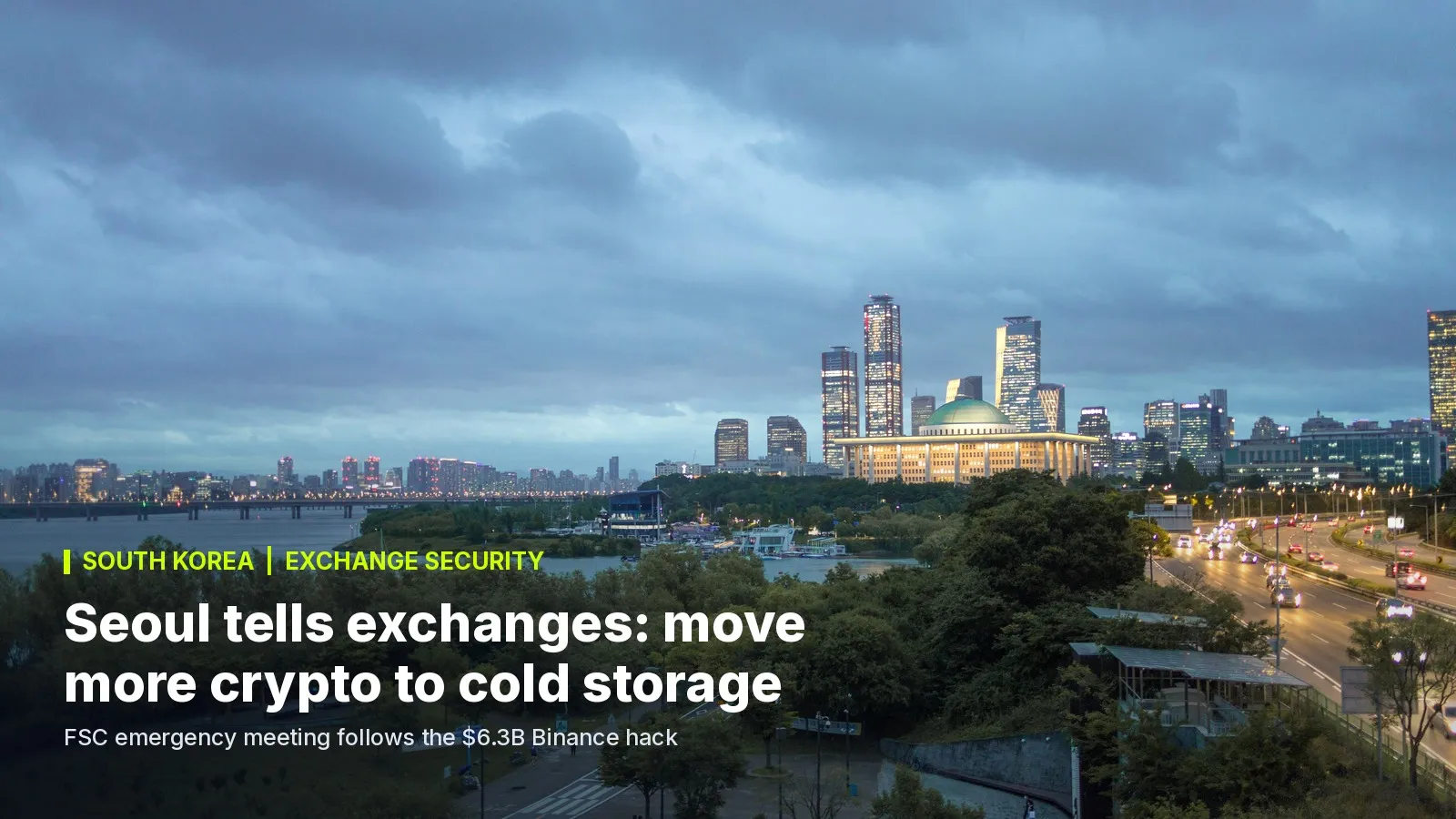
South Korea's top financial regulator has told the country's crypto exchanges to keep even more customer funds offline after the record $6.3 billion hack of Binance (BNB). At an emergency meeting on Monday, November 2 (Korea time), the Financial Services Commission (FSC) reviewed how local platforms guard their hot wallets and urged them to raise their cold-wallet ratios, tighten monitoring and set aside extra reserves.
The move is one of the first concrete regulatory responses anywhere to the Binance breach, which drained funds from the exchange's internet-connected wallets on October 29.
Key takeaways
- The FSC called an emergency meeting with the Financial Supervisory Service, the Financial Security Institute, the exchange alliance DAXA and major Korean exchanges.
- Exchanges were urged to hold a larger share of customer crypto in cold wallets, above the 80% legal minimum.
- Regulators also asked for round-the-clock deposit and withdrawal monitoring, more incident staff, faster reporting of suspicious access and additional reserves.
- Cold-wallet ratios at the five biggest Korean exchanges ranged from about 80.5% to 99.2% at the end of September.
- BNB traded near $699 on OKX, down about 2% in 24 hours.
What happened at the FSC emergency meeting
The meeting was chaired by Yoo Young-jun, the FSC's director general for digital finance policy. It brought together the Financial Supervisory Service (FSS), which carries out inspections, the Financial Security Institute, the Digital Asset eXchange Alliance (DAXA), which represents the country's won-based exchanges, and the major platforms themselves, including Upbit, Bithumb and Coinone.
Officials went through three areas that reports on the Binance attack have flagged as weak points:
- Access controls on exchanges' internal IT systems
- Approval and signing procedures for withdrawals from hot wallets
- Administrator privileges, meaning who inside a company can move funds or change settings
Korean media reports on the meeting noted that the Binance theft may have started with access to internal systems through employees' work laptops, followed by unauthorised use of the transaction approval and signing system. Binance has not published a full post-mortem, so that remains a working theory rather than a confirmed cause.
According to Chosun Biz, the FSC also asked the industry to report, through DAXA, how deposits and withdrawals at each exchange have been affected by the Binance incident.
What exchanges are being asked to do
The headline request is simple: keep more coins offline. A hot wallet is connected to the internet so an exchange can process withdrawals quickly, which also makes it the easiest target for attackers. A cold wallet is kept offline, so funds can't be moved without physical access and several sign-offs.
Beyond cold storage, the FSC listed measures it wants put in place straight away:
- Continuous monitoring of deposits and withdrawals
- Extra staff ready to respond to incidents
- A fast system for reporting and sharing information about abnormal access attempts
- Additional reserves to cover customer losses if a breach does happen
The regulator said it will keep working with other agencies and the industry to prevent similar attacks and limit any damage.
Cold-wallet ratios at Korean exchanges: the numbers
South Korea already has one of the strictest custody rules in the world. Under the Virtual Asset User Protection Act, which took effect in July 2024, exchanges must keep at least 80% of users' crypto in cold storage. Customer cash deposits must be held at banks, and operators must either buy insurance or keep reserves of at least 3 billion won (about $2 million) for won-based exchanges.
Data from the FSS cited by local media show how far each major platform sat above that floor at the end of September:
- Upbit: 99.17%
- Bithumb: 94.76%
- Coinone: 85%
- Digital X (formerly Korbit): 82.79%
- GOPAX: 80.54%
All five meet the legal minimum, but the smaller platforms are only just above it, which is where pressure to raise the ratio is likely to bite hardest.
Why it matters
The Binance attack showed how much can disappear from a hot wallet in very little time. Blockchain intelligence firm TRM Labs said most of the roughly $6.3 billion was moved in about 20 minutes. Binance has said the vast majority of user assets were in cold storage and has been replacing the stolen funds (see our coverage of Binance's 90% replacement and the SAFU fund and proof of reserves).
For Korea, a market where retail investors trade huge volumes on local exchanges, the regulator's message is that the hot-wallet layer is now the priority. It also comes as the Bank of Korea separately surveys 18 banks and 13 brokerages on their exposure to crypto risks, including major exchange hacks and long downturns. That review started before the Binance attack.
The FBI has attributed the Binance theft to North Korea's TraderTraitor group, a claim Pyongyang rejected this week, as covered in North Korea denies the FBI's attribution.
Market reaction
Prices barely moved on the news, with the wider market drifting lower. OKX prices at the time of writing:
- BNB: about $699, down 2.2% in 24 hours
- Bitcoin (BTC): about $77,190, down 1.7%
- Ethereum (ETH): about $2,259, down 1.6%
You can follow more live prices on the Nodora charts page.
What to watch next
- Whether the FSC turns its request into a formal rule, such as a higher legal cold-wallet minimum
- Updated cold-wallet ratios from the smaller exchanges closest to the 80% floor
- A wider financial-sector security review, which TokenPost reports is scheduled for Thursday, November 5 in Korea
- Whether other regulators, in Japan, Hong Kong or Europe, issue similar custody guidance after the Binance hack
This article is for information only and is not financial advice.
SourcesCointelegraph, The Asia Business Daily, Chosun Biz +36
- CointelegraphSouth Korea urges exchanges to boost cold storage after Binance hack
- The Asia Business DailyFSC Holds Emergency Meeting After Binance Hack, Urges Greater Use of Cold Wallets
- Chosun BizSouth Korea orders exchanges boost reserves after Binance hacking withdrawals
- Money TodayFinancial Services Commission conducts emergency inspection of domestic exchanges following Binance hack
- SBS NewsFSC Urges Domestic Crypto Exchanges to Boost Reserves After Binance Hack
- TokenPostSouth Korea's FSC Reviews Exchange Security and 80% Cold-Wallet Rule
This article is general information, not financial advice.
Open Nodora News in the app