Bitcoin (BTC) Trading Comes to Moscow Exchange on December 1
By Nodora News ·
Moscow Exchange plans to launch Bitcoin (BTC), Ether and USDT trading on Dec. 1, Russia's first organised crypto market, with caps on retail buyers.
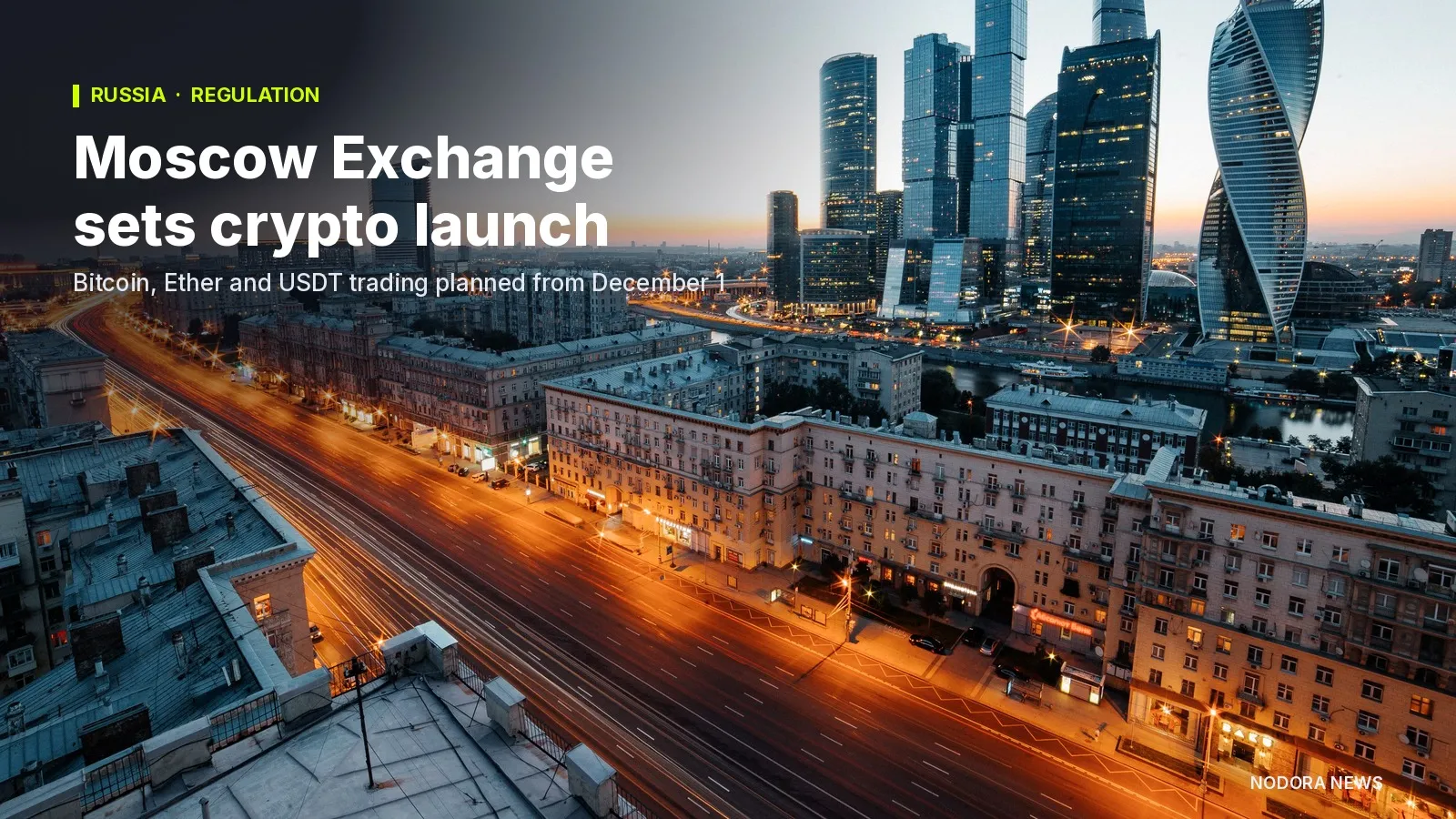
Bitcoin (BTC), Ether (ETH) and Tether's USDT are set to start trading on the Moscow Exchange on December 1, 2026. Russia's largest exchange, known as MOEX, said in a press release on Monday, November 2, that it will open what it calls the country's first organised market for digital currencies, using the same infrastructure it already runs for stocks. Retail investors will face a knowledge test and a yearly purchase cap of 300,000 rubles, about $3,700, per broker.
Key takeaways
- Moscow Exchange plans to launch Bitcoin, Ether and USDT trading on December 1, starting with pilot trades.
- Trades will be cleared by the exchange's National Clearing Center (NCC) and run from 06:50 to 23:50 Moscow time.
- Non-qualified (retail) investors must pass a test and can buy at most 300,000 rubles of crypto a year through each broker.
- The launch follows Russia's new crypto law, whose main rules took effect on September 1, 2026. Paying for everyday goods with crypto stays banned.
- MOEX and the NCC are under US and UK sanctions, and the EU added the exchange to its list in July 2026, which may limit who can take part.
What Moscow Exchange announced for Bitcoin and crypto trading
The plan is for trading to begin with a small number of pilot deals, with brokers and other market participants joining as their systems are ready. According to the exchange, interest has come both from firms that already trade traditional instruments on MOEX and their clients, and from businesses that use digital currencies for investment and settlement.
Three assets will be listed first: Bitcoin, Ether and the USDT stablecoin, a token designed to track the US dollar. The exchange said it will later widen the list with both international and Russian digital assets.
Orders will go through an electronic order book, where buyers and sellers post competing prices. From day one, clients will be able to trade with same-day settlement (known as TOD, or "today") and next-day settlement (TOM, or "tomorrow"). MOEX will also offer swap transactions, which let participants temporarily exchange one asset for another to manage liquidity, similar to the repo deals used in stock markets. Trades will be available in what the exchange calls addressable and addressless modes, though it hasn't explained those formats in detail.
The exchange won't hold the coins itself. Boris Blokhin, MOEX's senior managing director for sales and business development, said at the Smart-Lab investment conference in Moscow on October 31 that custody and record-keeping will be handled by partner digital depositories. He added that the exchange had been testing crypto trades with professional participants since early October.
The rules: who can buy and how much
The new market runs under Russia's federal law No. 282-FZ on digital currencies and digital rights. Its main provisions came into force on September 1, 2026, with some further rules due in July and September 2027.
- Retail investors: must pass a knowledge test first, then can buy up to 300,000 rubles (roughly $3,700) of approved crypto per year through a single broker.
- Qualified investors: no equivalent annual cap, although testing rules still apply.
- Approved coins: the Bank of Russia picked BTC, ETH and USDT for retail access based on criteria such as trading history, liquidity and market value.
- Payments: using crypto to pay for goods and services inside Russia remains banned, while some cross-border uses are allowed.
The exchange has said its existing licence as a trading organiser covers the new service, so it doesn't need a separate authorisation.
Why the Moscow Exchange launch matters
Russia has long had a large population of crypto users who mostly traded on offshore platforms or through peer-to-peer deals. Blokhin argued that the timing is right because, in his words, a crypto exchange leaves Russia or stops serving Russian clients almost every week. A regulated, domestic venue gives local brokers and investors a way to buy Bitcoin inside the country's own legal and clearing system.
For the wider market, the move is another sign of large traditional exchanges adding spot crypto. It also brings Bitcoin and Ether into a market that is largely cut off from Western finance. MOEX and the NCC have been under US sanctions since June 2024, the UK sanctioned the exchange at the same time, and the European Union added it to its sanctions list in July 2026. That means Western firms are very unlikely to connect, and liquidity is expected to come mostly from Russian participants.
Not everyone expects much demand. Sergey Mendeleev, founder of the cross-border payments platform Exved, told Cointelegraph he doubted either the global or local market would notice the launch, and warned that retail investors could face very wide spreads (the gap between buying and selling prices). He did see possible value if the venue helps importers and exporters trade crypto with each other for foreign payments. MOEX, for its part, says demand for its existing crypto-linked futures has been steady.
Market reaction: Bitcoin and Ether prices
The announcement hasn't moved prices in any visible way, with the market still focused on ETF outflows, the US midterm elections and the aftermath of the record Binance hack. On OKX at about 00:55 AEDT on November 4 (13:55 UTC on November 3):
- Bitcoin (BTC): about $77,470, down roughly 0.6% over 24 hours
- Ether (ETH): about $2,288, roughly flat
- USDT: holding its dollar peg
Recent pressure on Bitcoin has come mainly from US funds, as covered in Bitcoin (BTC) ETF Outflows: BlackRock's IBIT Sheds $405M in a Day. You can follow live prices on the Nodora charts page.
What to watch next
- December 1 launch: whether the first pilot trades go ahead on schedule and how many brokers connect in the first weeks.
- Liquidity and spreads: early trading volumes and the gap between bid and ask prices will show whether the critics' concerns are justified.
- New listings: MOEX has said it will add more digital assets over time, including Russian instruments.
- Further rules: more parts of the crypto law take effect in 2027, which could change how Russians access crypto outside the exchange.
- Sanctions: any new Western measures targeting Russian crypto infrastructure could affect how the market develops.
This article is for information only and is not financial advice.
SourcesCointelegraph, Finance Magnates, crypto.news +36
- CointelegraphMoscow Exchange to launch Bitcoin, Ether and USDT trading in December
- Finance MagnatesMoscow Exchange to Launch Digital Currency Trading With BTC, ETH and USDT
- crypto.newsMoscow Exchange plans Bitcoin, Ethereum and USDT trading from December 1
- Investing.com (Russian)Мосбиржа с 1 декабря начнет торги биткоином, Ethereum и USDT
- InterfaxМосбиржа считает запуск торгов криптовалютами в РФ своевременным
- OKXBTC-USDT and ETH-USDT market data
This article is general information, not financial advice.
Open Nodora News in the app