Bitcoin Miner Core Scientific Exits Mining by Year-End
By Nodora News ·
Core Scientific will finish winding down Bitcoin mining in Q4 2026 and enter 2027 as a pure-play AI colocation provider after Q3 results.
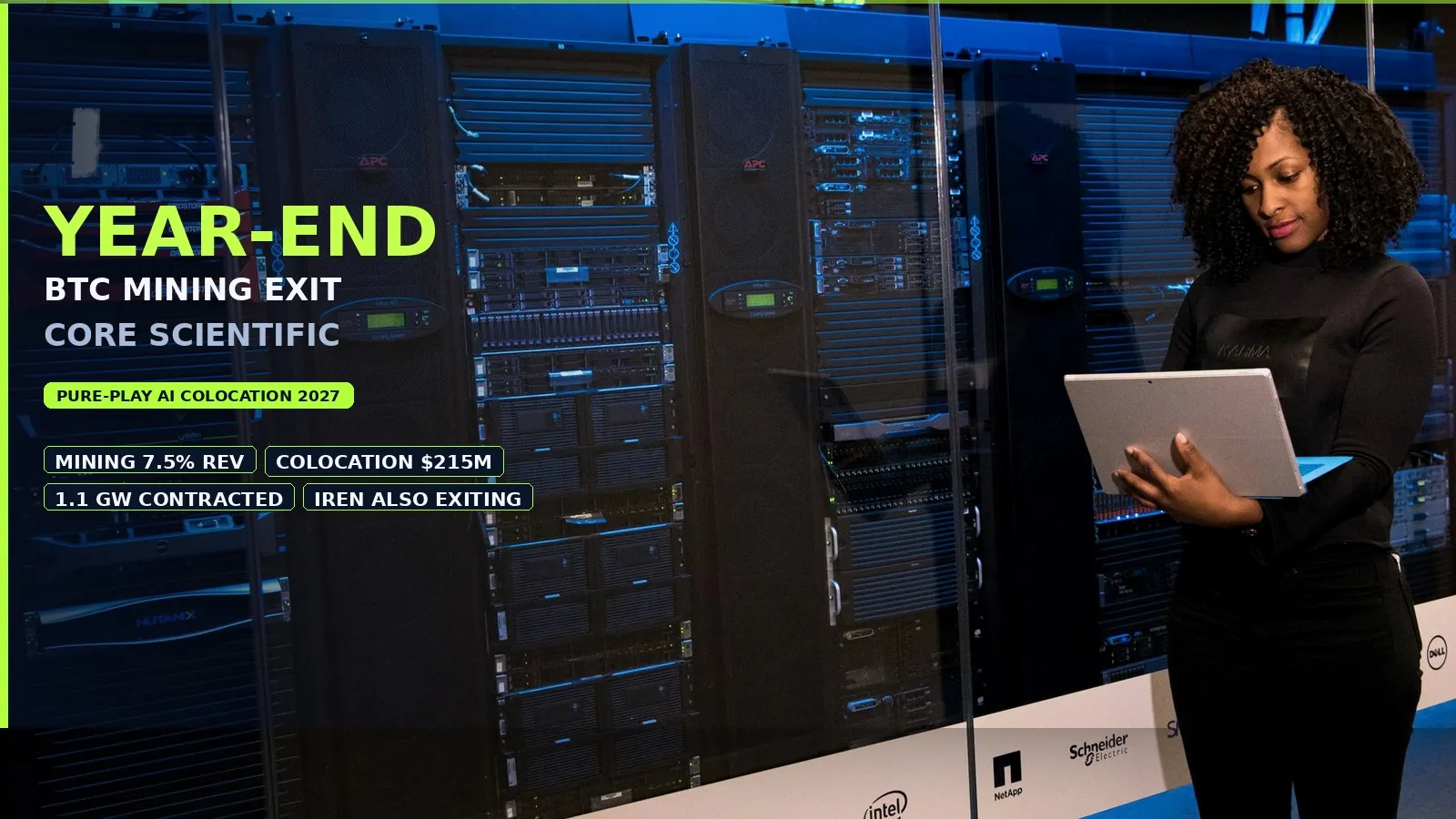
Core Scientific (Nasdaq: CORZ), once among the largest U.S.-listed Bitcoin (BTC) miners, said on its third-quarter earnings call that it expects to finish exiting Bitcoin mining by the end of 2026 and start 2027 as a pure-play high-density colocation provider for artificial intelligence and high-performance computing.
Chief Financial Officer Jim Nygaard told investors the company expects to “complete the wind-down during the fourth quarter.” Chief Executive Officer Adam Sullivan put the same deadline more bluntly: “We expect to complete our exit from Bitcoin mining by year end.” The remarks accompanied Q3 results for the period ended September 30, 2026, filed with the U.S. Securities and Exchange Commission and covered by Cointelegraph, Bitcoin Magazine, and the Motley Fool earnings transcript.
Key takeaways
- Core Scientific targets a full Bitcoin mining exit by year-end 2026, entering 2027 as a pure-play AI/HPC colocation landlord.
- Q3 mining was only about 7.5% of revenue ($17.5 million of $232.9 million); colocation brought in $215.4 million.
- Miners online were nearly 50% fewer at end-September versus year-end 2025; self-mining posted a gross loss.
- About 1.1 GW is contracted with CoreWeave and AMD; management cites roughly $1.8 billion average annual run-rate revenue once fully delivered and billing.
- Peer IREN separately said it aims to substantially complete its own mining-to-AI transition by December 31, 2026.
What Core Scientific said
The exit date is not a brand-new strategy — a July quarterly filing had already said hosted mining would end by December 31 as self-mining wound down — but the Q3 call locks in a targeted completion for the entire Bitcoin mining franchise in the fourth quarter.
Nygaard said Core Scientific had nearly 50% fewer miners online at the end of September than at year-end 2025. Digital assets on the balance sheet stood at about $2.7 million on September 30, down from $49.7 million three months earlier and $222 million at year-end 2025, underscoring how far the company has moved away from holding mined coins.
The pivot has already carried costs. Core Scientific booked about $266.5 million in mining-related asset impairments in the first quarter of 2026, citing weaker Bitcoin prices, historically low hashprice, and falling secondary-market values for mining gear. In the second quarter it terminated a mining-equipment agreement with Block and Proto, recording a $41.9 million loss.
The numbers behind the pivot
Colocation — renting power, cooling, and floor space so customers can run their own compute — is now the business.
- GAAP colocation revenue: $215.4 million in Q3, up nearly 60% sequentially.
- Digital-asset self-mining revenue: $12.3 million, down from $57.4 million a year earlier.
- Hosted mining for third parties: $5.2 million, down from $8.7 million.
- Combined Bitcoin mining: $17.5 million, or about 7.5% of $232.9 million total revenue.
- Self-mining gross loss: about $7.5 million; colocation gross profit about $128.4 million (~60% margin).
- Adjusted EBITDA: about $133.6 million, up from about $41 million in Q2, with the margin expanding to about 57% from 25%.
Sullivan said Core Scientific is billing CoreWeave for 485 megawatts across five campuses — up 90 MW in the quarter — with roughly 100 MW still in commissioning and expected to start recognizing revenue over the next few months. Beyond CoreWeave’s contracted 590 MW, the company has 530 MW under an AMD-backed agreement across five campuses, with initial delivery targeted for the first half of 2027 and full delivery by the end of 2028.
Together those relationships cover about 1.1 gigawatts. Once fully delivered and billing, management expects that portfolio alone to generate about $1.8 billion in average annual run-rate revenue and about $1.6 billion in net operating income. Liquidity at quarter-end was about $1.7 billion, including roughly $800 million in cash.
Sullivan also said the company does not expect the U.S. midterm election results to affect existing operations or delivery timelines for capacity already under development — a point aimed at investors watching state-level pushback on large data-center power loads.
Why it matters for Bitcoin mining
Core Scientific’s timeline is one of the clearest public signals yet that a former mining heavyweight is choosing AI power contracts over hash rate. The same week, IREN reported Bitcoin mining revenue of $28 million for the three months ended September 30 — down 58% quarter over quarter and 88% year over year — and wrote in its 10-Q that it aims to “substantially complete” its transition from mining to AI Cloud by December 31, 2026, with only immaterial mining expected through calendar 2027.
That pattern sits alongside other U.S. miners leasing campuses and power to AI tenants rather than expanding hash rate alone. Nodora has tracked related deals, including Riot’s $28 billion AI data-center lease in Texas, TeraWulf’s Google-backed $19 billion AI lease, and American Bitcoin’s Q3 results, which still emphasize a mine-and-hold model even as peers pivot. Live Bitcoin prices and related charts sit on Nodora’s charts page.
For the Bitcoin network, large public miners exiting reduce one visible source of industrial hashrate and secondary hardware demand, but they do not by themselves change the protocol’s difficulty adjustment. The bigger near-term story is capital and power: who can finance high-density halls, and which grids and communities will host them.
Market reaction
At the time of writing on OKX, Bitcoin (BTC) traded near $75,857, roughly flat over 24 hours (about −0.2%), and Ethereum (ETH) near $2,232, down about 0.8%. Soft-to-stable spot prices are a backdrop for the earnings week rather than a one-for-one reaction to Core Scientific’s wind-down comments; equity markets had already sold off AI and tech names midweek, and IREN’s Nasdaq shares fell hard on its own results print.
What to watch
Watch whether Core Scientific turns the last machines off on the Q4 schedule and whether AMD project financing lands in time for the 2027 delivery slate. Also watch how much hashrate peers still report as they convert floor space, and whether any remaining mining-only public companies lean harder into treasury or hosting models. None of this is financial advice; it is a corporate strategy shift with clear implications for how U.S. listed miners allocate power after a weak hashprice year.
SourcesCointelegraph, Bitcoin Magazine, The Motley Fool +25
- CointelegraphCore Scientific to quit Bitcoin mining by year-end as AI business surges
- Bitcoin MagazineCore Scientific (CORZ) to Exit Bitcoin Mining by Year-End as Colocation Hits $215 Million
- The Motley FoolCore Scientific (CORZ) Q3 2026 Earnings Call Transcript
- The BlockIREN's bitcoin mining revenue drops 58% as firm plans full exit by year-end
- SEC EDGARCore Scientific Q3 2026 earnings exhibit
This article is general information, not financial advice.
Open Nodora News in the app