Circle (CRCL) Q3 Earnings Beat as USDC Volume Hits $13.9 Trillion
By Nodora News ·
Circle (CRCL) beat Q3 earnings forecasts with $226M net income as USD Coin (USDC) volume rose 49% to $13.9T, while it quietly cut 5% of staff.
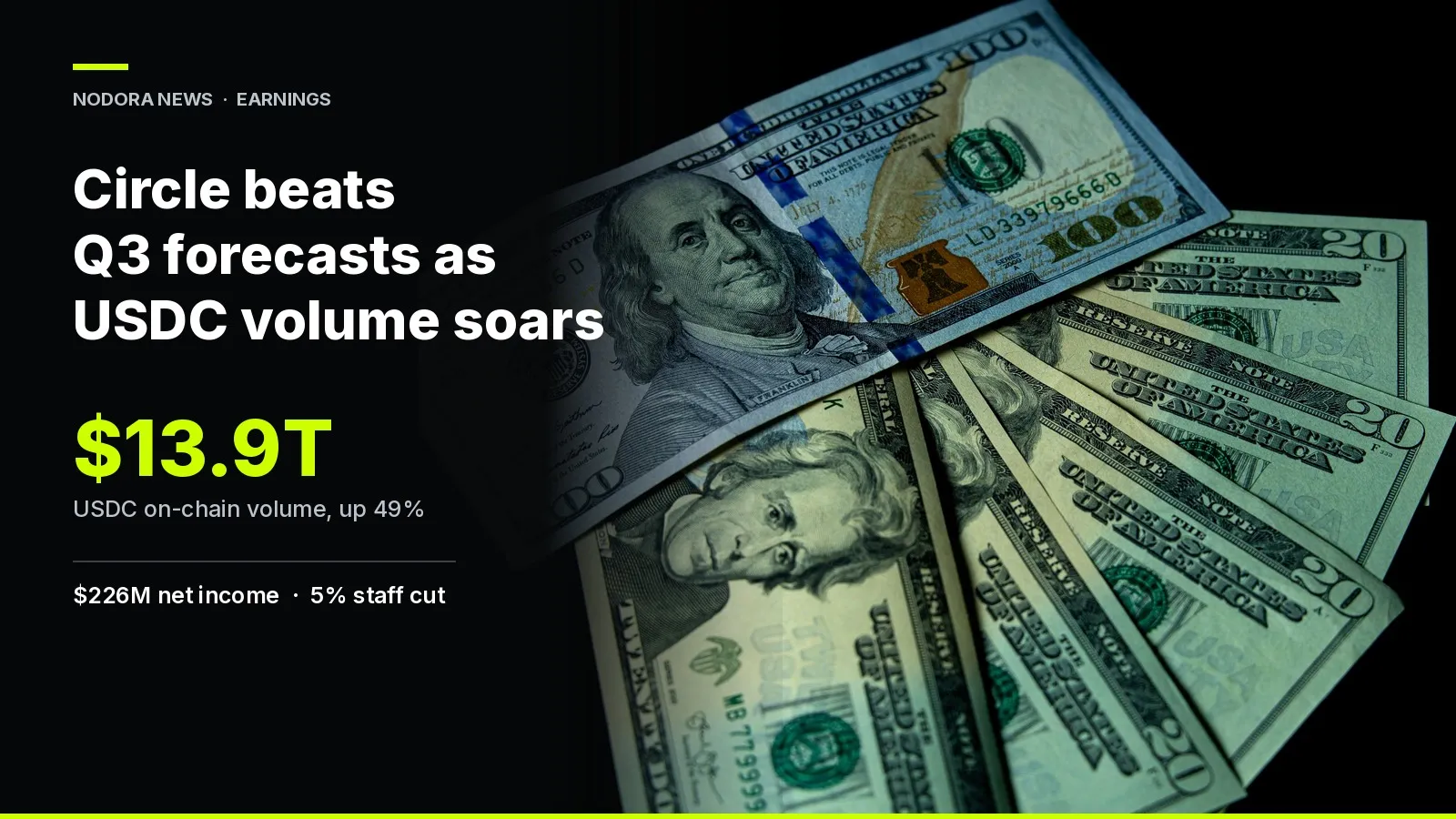
Circle Internet Group (CRCL), the company behind the USD Coin (USDC) stablecoin, reported third-quarter results on Wednesday, November 4, that comfortably beat Wall Street forecasts. Net income from continuing operations rose 5% year over year to $226 million, adjusted earnings came in at 84 cents a share against an expected 37 cents, and on-chain USDC transaction volume jumped 49% to $13.9 trillion. The same release also revealed that Circle cut about 5% of its workforce during the quarter.
Key takeaways
- Circle's Q3 net income from continuing operations was $226 million, up 5% from a year earlier.
- Adjusted EPS of 84 cents beat the 37-cent consensus, and total revenue and reserve income of $865 million (up 17%) topped the roughly $778 million analysts expected.
- USDC moved $13.9 trillion on-chain in the quarter, up 49%, and Circle says it carried 79% of all stablecoin transaction volume.
- Reserve income, Circle's biggest revenue line, fell 8% to $658 million as interest rates dropped.
- Circle cut about 5% of staff, booking a $9.1 million restructuring charge.
What happened: Circle's Q3 2026 earnings in brief
Circle published its third-quarter numbers early on Wednesday, US time. The headline result was a clear beat on both profit and revenue. According to CoinDesk, the adjusted EPS figure was about 127% higher than the analyst forecast, and revenue beat expectations by more than 11%.
Adjusted EBITDA, a measure of operating profit that strips out items such as interest, tax and stock-based pay, climbed 85% to $317 million.
The quarter also included several strategic milestones that Circle highlighted alongside the numbers:
- The public mainnet launch of Arc, Circle's own blockchain, in September, with BlackRock, DTCC and Visa among its permissioned validators.
- An agreed deal to buy Tazapay, a Singapore-based payments network.
- A $100 million investment from crypto exchange Binance.
The numbers behind USDC growth
USDC is a dollar-pegged stablecoin: each token is meant to be redeemable for one US dollar, backed by cash and short-term Treasuries. Circle earns most of its money from the interest on those reserves, so the amount of USDC in circulation and the level of interest rates both matter a lot.
Here is how the main USDC figures looked in Q3:
- On-chain volume: $13.9 trillion, up 49% year over year.
- Average circulation: $73.3 billion, up 8% from a year earlier.
- End-of-quarter circulation: $73.9 billion, roughly flat on the quarter.
- Mint and redeem activity: a record $208 billion, or about $2.3 billion a day, according to CEO Jeremy Allaire.
- Share of US dollar stablecoin supply: about 27%, per the company.
Allaire also said Circle's payments network ended the quarter at $41 billion in annualised volume, a 15-fold increase.
There is a gap between activity and supply here. USDC is being used far more, but the total amount outstanding barely moved during the quarter. With USDC at about 27% of dollar stablecoin supply, most of the market sits with rivals such as Tether, whose CEO recently said the company holds about 150,000 bitcoin. You can read our earlier report on Tether's bitcoin holdings.
Why it matters: falling rates and new revenue sources
The most important detail for investors may be the shift in where Circle's revenue comes from. Reserve income fell 8% to $658 million because the yield on the assets backing USDC has dropped as interest rates came down. That is a structural pressure for any stablecoin issuer that relies on interest.
Other revenue rose to $207 million. Most of that, about $182 million, came from a private presale of ARC, the native token of the Arc blockchain. That is a large, one-off style boost, so it is worth separating from Circle's recurring business when judging the quarter.
The 5% job cut sits awkwardly next to a profitable quarter. Circle said in footnotes to its financial tables that the move was designed to better align its organisational structure with its operating model and strategic priorities. It did not say how many people were affected. The $9.1 million restructuring charge, mostly severance and notice-period pay, was partly offset by a $5.7 million reversal of stock-based compensation for unvested shares that departing staff forfeited. Decrypt noted that Allaire did not mention the cuts in his public comments on the results.
Circle joins a long list of crypto firms that have trimmed staff in 2026, including Coinbase, BitGo, Bitwise and the Ethereum Foundation.
Market reaction: CRCL shares and crypto prices
Circle's stock did not rally on the beat. CRCL traded about 1.2% lower at $74.33 in US pre-market trading, after closing up 4.4% at $75.22 on Tuesday, CoinDesk reported.
The wider crypto market was steady at the time of writing, according to OKX spot prices:
- USDC: about $1.001, holding its peg.
- Bitcoin (BTC): about $78,340, up roughly 1.1% in 24 hours.
- Ethereum (ETH): about $2,317, up roughly 1.4%.
You can track more coins on the Nodora charts page.
What to watch next for Circle and USDC
- The GENIUS Act. Allaire said the US stablecoin law takes effect in January and that "regulated digital dollars go mainstream" then. How quickly banks and payment firms adopt USDC under the new rules will shape Circle's growth.
- Interest rates. Further rate cuts would keep squeezing reserve income, making supply growth and non-interest revenue more important.
- Arc adoption. Arc now has more than 100 institutions and apps, according to Allaire. Big traditional finance players such as DTCC are also moving into tokenisation, as covered in our report on Morgan Stanley tokenizing US stocks and Treasuries via DTCC.
- Market share. USDC carries most stablecoin transaction volume, but holds only about 27% of dollar stablecoin supply. Watch whether that gap narrows.
This article is for information only and is not financial advice.
SourcesCoinDesk, Decrypt, OKX3
This article is general information, not financial advice.
Open Nodora News in the app