GOPAX Halts Trading After Hacking Threat in South Korea
By Nodora News ·
South Korean exchange GOPAX suspended trading, deposits and withdrawals on Nov. 6 after an email hacking threat, with no confirmed asset loss.
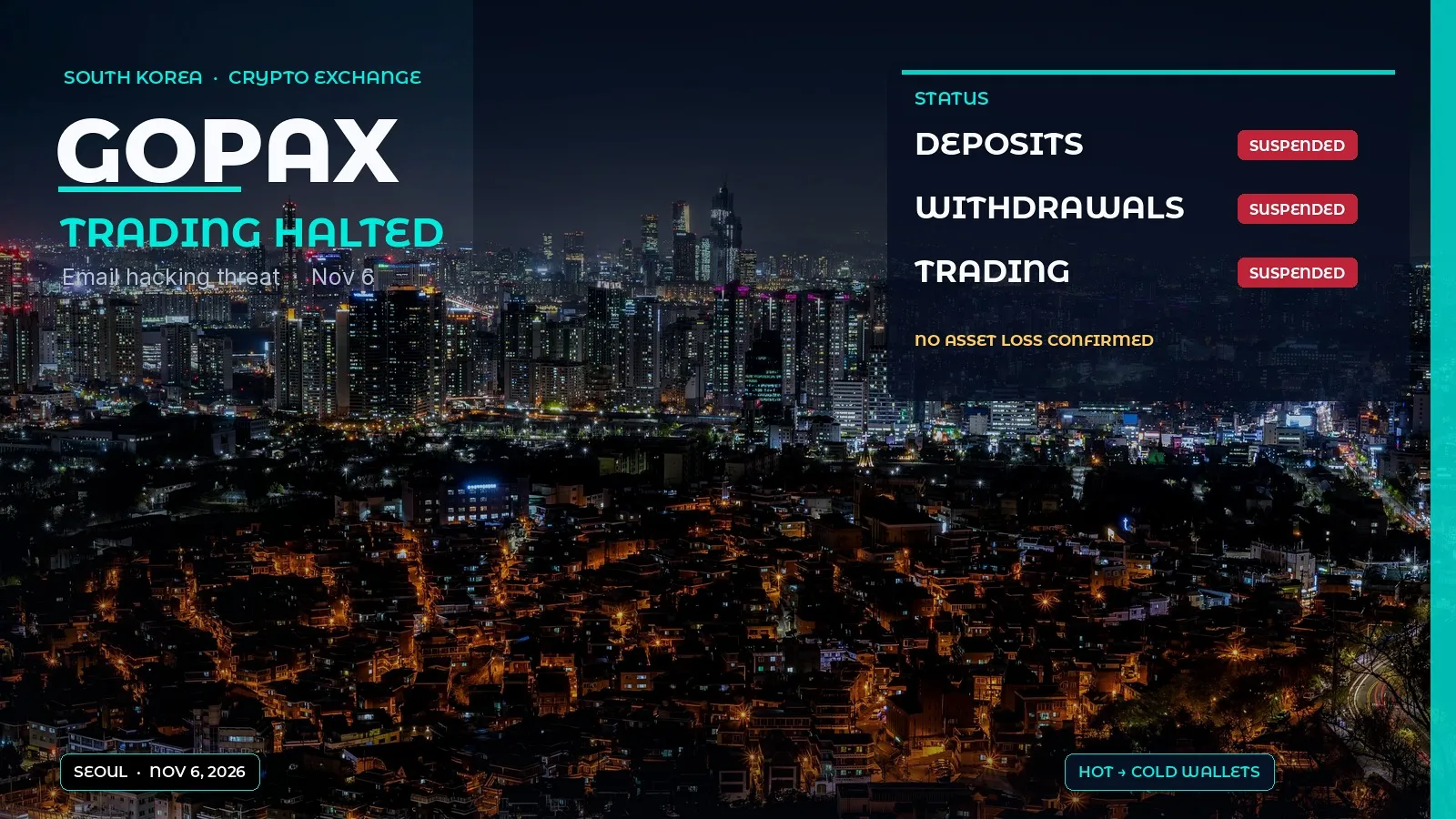
South Korean cryptocurrency exchange GOPAX suspended deposits, standard withdrawals, and trading on Friday, November 6, 2026, after receiving an email that claimed the platform had been hacked. The company said it had not verified the threat as genuine and reported no confirmed asset loss, while moving funds from hot wallets into offline cold storage as a precaution. Bitcoin (BTC) was trading softer across major venues as the halt landed, keeping market attention on exchange custody and cold-storage buffers after the recent Binance incident.
Key takeaways
- Withdrawals stopped at 2:55 p.m. KST (05:55 UTC) on Nov. 6; trading was suspended around 3:53 p.m. KST (06:53 UTC), and outstanding orders were canceled.
- GOPAX said the email came from a group claiming to have hacked the exchange; the threat is not yet verified, and no actual theft has been detected.
- Standard web and app withdrawals are disabled; customers can still request withdrawals via support with manual verification (slower).
- Assets are being moved from hot wallets to cold (offline) wallets; no resume date has been announced.
- End-September FSS data put GOPAX’s offline share at 80.54% — just above South Korea’s ≥80% cold-storage floor under the Virtual Asset User Protection Act, and well below Upbit (99.17%), Bithumb (94.76%), and Coinone (85%).
What happened on Nov. 6
According to Yonhap and GOPAX notices cited by crypto.news, the exchange halted deposits and routine withdrawals first, then stopped trading about an hour later. All open orders were canceled when markets froze. An official speaking anonymously to Yonhap said the firm received an email from a group claiming to have compromised the exchange, but that authenticity had not been confirmed.
The company framed the shutdown as customer-asset protection rather than a confirmed breach. Regular withdrawals through the website and mobile app are off; users who need to move funds must go through customer support, where each request is checked manually before approval. GOPAX has warned that this path will take longer than normal automated withdrawals. No timeline for restoring deposits, trading, or standard withdrawals has been published.
Cold storage numbers and regulatory pressure
The halt lands inside a sharper South Korean focus on how much customer crypto sits offline. Under the Virtual Asset User Protection Act, exchanges must keep at least 80% of the economic value of customer crypto in cold storage. Financial Supervisory Service figures for end-September showed GOPAX at 80.54% offline — compliant, but close to the floor — versus Upbit 99.17%, Bithumb 94.76%, and Coinone 85%.
That gap matters after the Financial Services Commission’s Nov. 2 emergency meeting with major platforms following the roughly $6.3 billion Binance hack. Officials pressed exchanges on withdrawal approvals, admin privileges, access controls, and monitoring, and urged heavier cold storage and faster response to suspicious flows. Nodora previously covered that Binance breach and its North Korea-linked reporting; separately, Gate’s recent Proof of Security push with 104.58% cold coverage shows how some global venues are marketing oversized offline buffers as a trust signal.
GOPAX’s own recent history adds context without proving a link to Friday’s email: an October customer-information leak involving seven customers and two employees, and a separate October 24 incident at Prabang exchange with about 100 million won (~$70,000) lost from a hot wallet. Broader finance is also under strain — the FSC has cited cybersecurity incidents at 37 financial institutions affecting roughly 470,000 customer records, per Yonhap.
Why the halt matters after Binance
Even a precautionary freeze is market structure news in Seoul. Retail users cannot trade or pull funds through normal rails until services restart, and manual support withdrawals create a bottleneck. For peers, the episode is another live stress test of the 80% cold-storage rule: platforms sitting near the minimum have less visible headroom than those already north of 90–99%.
Authorities have discussed raising the cold-storage floor toward as much as 99%, though no new mandatory threshold has been announced. Friday’s sequence — threat email, hot-to-cold migration, trading halt — will feed that debate whether or not the claim is later confirmed as real.
Market reaction
The GOPAX pause is a South Korea-specific operational event rather than a single-token catalyst, but it arrives while majors are already soft. On OKX at the time of writing:
- Bitcoin (BTC) near $75,703, down about 5.0% over 24 hours
- Ethereum (ETH) near $2,228, down about 6.8% over 24 hours
Live prices and related pairs remain on Nodora’s charts page.
What to watch
Watch for any official confirmation that the email threat was genuine or a hoax; forensic updates on whether intrusion attempts were logged; the share of assets successfully moved to cold storage; and a firm schedule for restoring deposits, trading, and automated withdrawals. Also watch whether the FSC or FSS issue fresh guidance on cold-storage ratios or withdrawal controls after this episode. None of this is financial advice — it is an operational security story with clear implications for customer access and Korea’s exchange custody standards.
SourcesYonhap, crypto.news, The Herald Business +25
- YonhapGOPAX suspends withdrawals, trading following hacking threats
- crypto.newsSouth Korea's GOPAX halts crypto trading, withdrawals after hacking threat
- The Herald BusinessGopax halts withdrawals, trading after receiving hacking threat email
- Seoul Economic DailyGopax Halts Withdrawals After Hacking Threat
- First News (fnnews)GOPAX suspends deposits, withdrawals and trading amid hacking threat
This article is general information, not financial advice.
Open Nodora News in the app