Greece Approves 10% Crypto Capital Gains Tax
By Nodora News ·
Greece's parliament approved a 10% cryptocurrency capital-gains tax on Nov. 5, with a €500 annual exemption and separate 15% interest rules on staking.
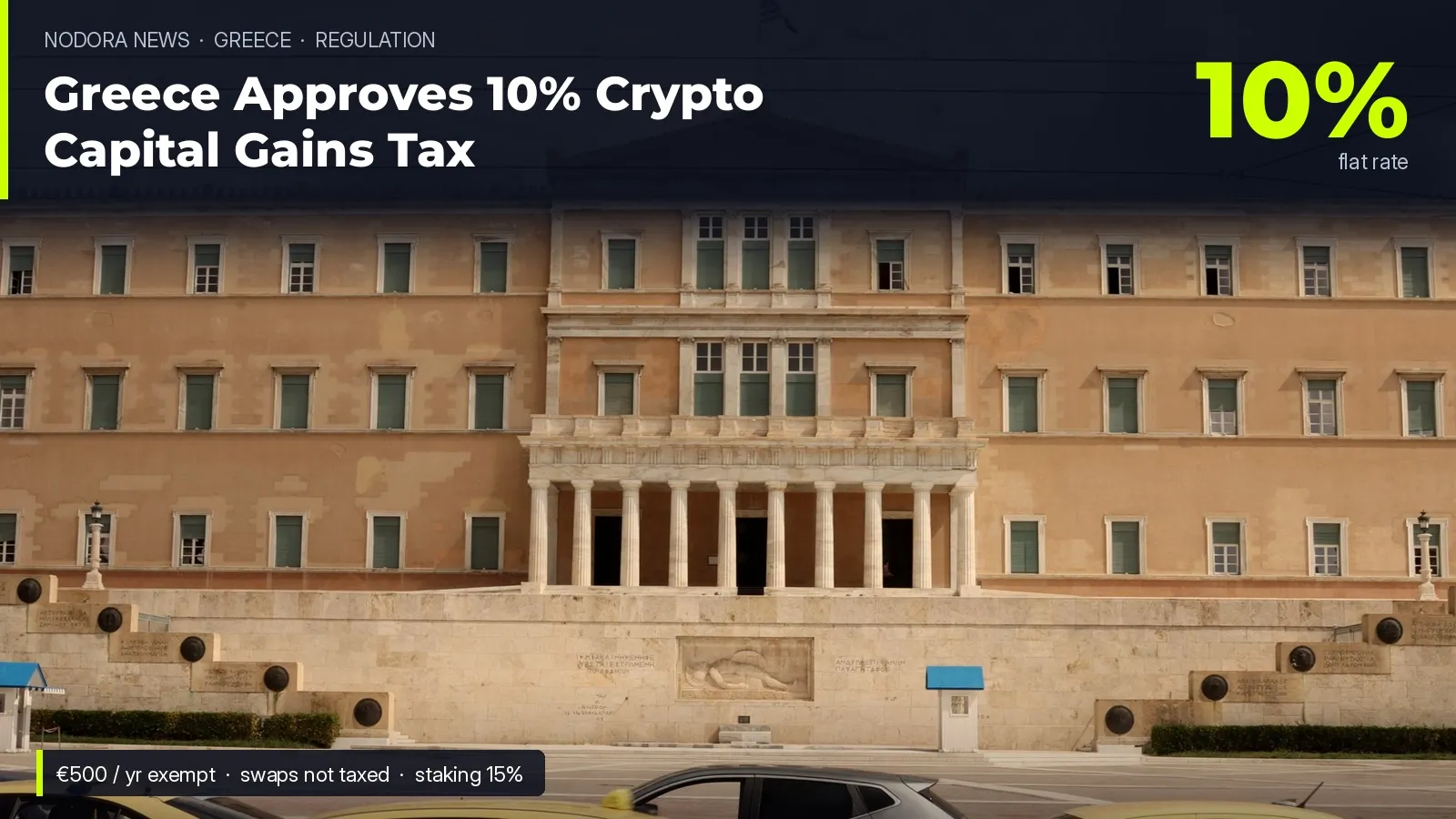
Greece’s parliament on Thursday, 5 November 2026, approved a 10% capital-gains tax on cryptocurrency, creating the country’s first dedicated legal framework for taxing crypto assets. Annual net gains of up to €500 (about $563) are exempt. A senior Finance Ministry official told Reuters that further directives on transparency and audits will follow in the coming weeks, and that the state has no firm revenue estimate because most Greek investors use foreign platforms.
Key takeaways
- Parliament passed a 10% capital-gains tax on crypto — Greece’s first comprehensive crypto-tax framework.
- Net annual gains up to €500 (~$563) are exempt; above that threshold the whole net gain is taxed at 10%.
- Crypto-to-crypto swaps are not treated as taxable transfers; sales for fiat, or for goods and services, are.
- Staking, lending and liquidity-provision returns are treated as interest and taxed at 15%.
- A 12-month voluntary declaration window covers past gains without fines or interest if conditions are met; crypto sales are exempt from the Digital Transaction Fee.
- EU DAC8 platform reporting already applies from 1 January 2026, with the first cross-border exchanges due by 30 September 2027.
What parliament approved
Lawmakers in Athens cleared a bill that inserts dedicated crypto rules into Greek tax law after months of consultation. Reuters reporting, carried by eKathimerini and other wires, describes the measure as the first comprehensive framework for taxing crypto assets in Greece. European Union countries still do not share a single crypto tax system; member-state capital-gains rates commonly range from about 8% to 30%.
The path to Thursday’s vote was visible earlier this year. In June, officials had discussed a 15% rate. By early October a consultation draft had settled on 10%, keeping the €500 annual exemption, with a parliamentary timetable aimed at the first week of November. The ministry says implementing directives — including transparency and audit rules — will be published in the coming weeks. Revenue cannot be projected with confidence, the same Reuters briefing said, because most Greek crypto investors use platforms based abroad.
The numbers and the rules
Capital gains at 10%. Taxable “transfers” generally include selling crypto for money, using it to buy goods or services, and contributing crypto to company capital. The gain is the difference between acquisition and transfer price, often using an average cost where lots were bought over time. If acquisition cost cannot be proven, it may be treated as zero.
€500 exemption. Net capital gains of up to €500 per tax year, after allowed loss offsets, are exempt. Coverage of the bill’s explanatory approach treats this as a threshold, not a per-gain deduction: stay at or below €500 and pay nothing; go above and the full net gain is taxed at 10%.
Swaps vs cashing out. Exchanging one crypto asset for another is not treated as a taxable capital-gains event under the consultation framing. Tax crystallises when crypto is sold for fiat or spent on goods or services. Holders still need swap records so cost basis can be rebuilt for a later taxable disposal.
Staking, lending and LP at 15%. Returns from lending, liquidity or yield mechanisms and staking are classified as interest and taxed at 15%, separately from the 10% capital-gains track. The €500 cushion does not apply to that interest income. Rewards paid in crypto are valued in euro at receipt for the interest tax.
Losses, past gains and fees. Losses above €500 in a year may be carried forward for up to five years, but only against future crypto capital gains. A 12-month voluntary declaration window lets individuals report earlier transfers (and related yield income under the bill’s design), pay on a short deadline, and avoid fines and interest if conditions are met — without automatically clearing questions about the origin of purchase funds. Crypto sales are exempt from Greece’s Digital Transaction Fee. Core income-tax changes are framed for tax year 2027, with inheritance and gift valuation rules keyed to liabilities from 1 January 2027 in draft analyses.
Why it matters — and how DAC8 fits
A flat 10% with a small retail exemption sits toward the lower end of Europe’s patchwork of crypto capital-gains rates, and the swap deferral is clearer than in jurisdictions that tax crypto-to-crypto exchanges as disposals. The enforcement backdrop is EU DAC8: covered crypto service providers collect reportable data on EU residents from 1 January 2026, and the first exchanges of 2026 activity between tax authorities are due by 30 September 2027. That reporting path does not depend on Greece’s rate; it slowly closes the foreign-platform gap the ministry cited. Nodora has also tracked: France’s Assembly shelved crypto amendments when it rejected the 2027 budget revenue section (France Crypto Tax: Budget Rejection Shelves €100K Wallet Rule), while Hong Kong passed a CARF-aligned exchange reporting law (Hong Kong Crypto Tax Law Passed: Exchanges to Report From 2027).
Market reaction
This is a Greece-specific tax story, not a single-token catalyst. At draft time on OKX spot, major coins were soft in a broader risk-off session:
- Bitcoin (BTC) near $75,700, down roughly 6.4% over 24 hours
- Ethereum (ETH) near $2,230, down about 8.6% over 24 hours
Price action tracked the wider market rather than an Athens-only move. Live prices: Nodora Charts.
What to watch next
- Finance Ministry directives on transparency, audits and documentation.
- IAPR / AADE guidance on forms, evidence and the €500 / average-cost rules.
- The 12-month voluntary declaration clock once entry-into-force dates are final.
- DAC8 exchanges through 30 September 2027, as foreign platforms report to Greek authorities.
Greece now has a written crypto-tax rulebook. The rate is lower than June’s trial balloon, swap treatment is relatively clear, and yield sits on a separate 15% interest track — but the test will be audit directives and how DAC8 fills the foreign-platform gap the ministry highlighted.
SourcesReuters via eKathimerini, Reuters via Euronext Live, Business Recorder (Reuters) +47
- Reuters via eKathimeriniParliament approves 10% tax on cryptocurrency gains
- Reuters via Euronext LiveGreek parliament approves 10% tax on cryptocurrency gains
- Business Recorder (Reuters)Greek parliament approves 10% tax on cryptocurrency gains
- crypto.newsGreece approves 10% crypto gains tax with €500 exemption
- eKathimeriniGreece plans 10% cryptocurrency capital gains tax
- PwC GreeceDraft Law: New Tax Framework for Crypto Assets
- Euro2day (G. Dalianis / Artion)Κρυπτονομίσματα: Φόρος 10% στα κέρδη και νέοι κανόνες
This article is general information, not financial advice.
Open Nodora News in the app