Nigeria CBN Sets ₦15bn Stablecoin Issuer Capital Rules
By Nodora News ·
Nigeria’s CBN stablecoin licensing rules took effect Nov. 5, with ₦15bn Class 2 capital, a 180-day licence window, and an algorithmic token ban.
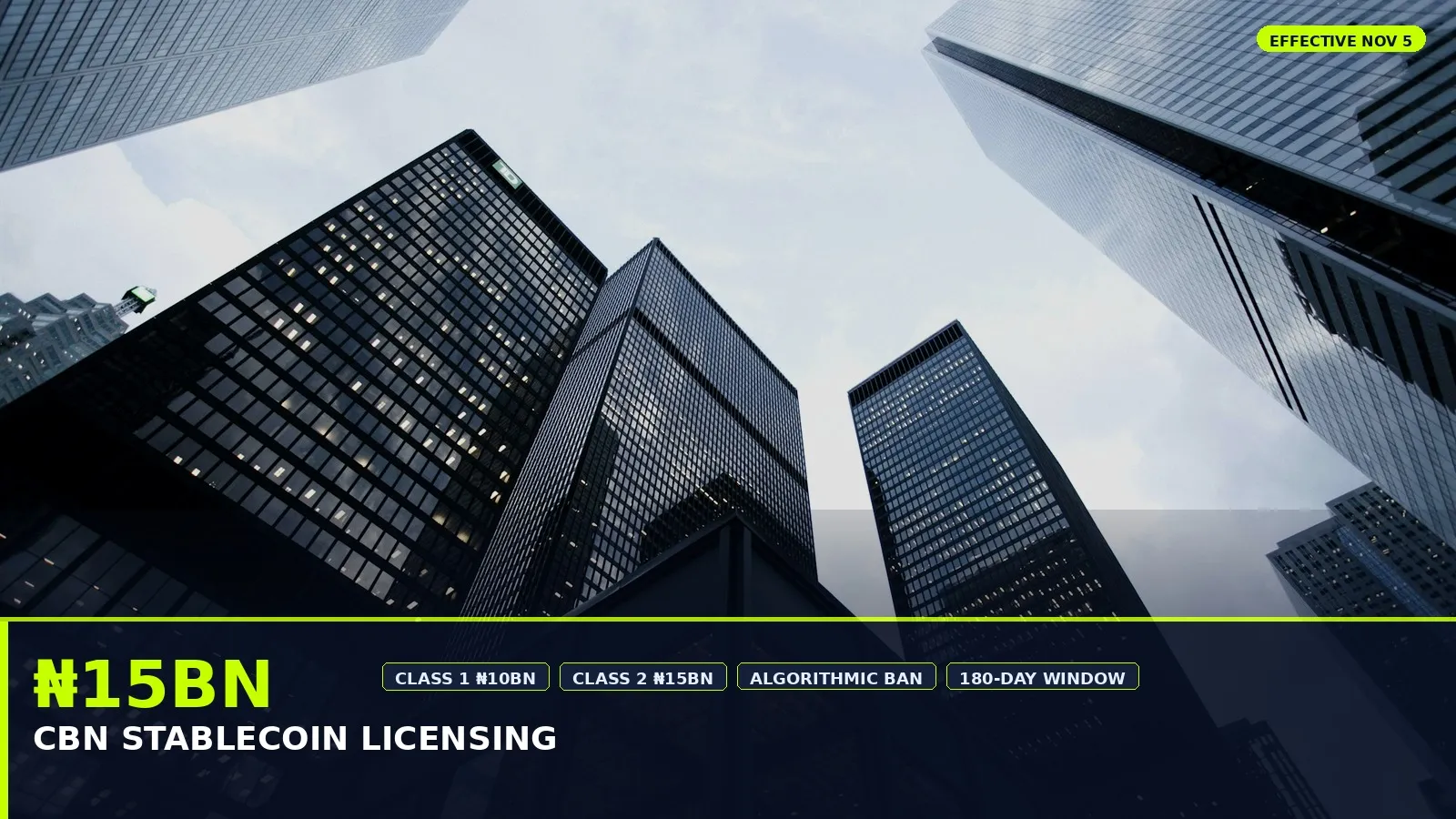
The Central Bank of Nigeria (CBN) has put new licensing rules for stablecoin issuers and other non-security virtual asset payment firms into force, creating separate capital tracks for naira-referenced and foreign-currency tokens and banning algorithmic designs. The Regulations for the Operations of Non-Security Virtual Assets in Nigeria took effect on November 5, 2026, according to a circular signed by Payments System Policy Department director Musa Jimoh and covered by The Block, Punch, BusinessDay, and TechCabal.
Foreign-currency stablecoins offered to people in Nigeria — including dollar-pegged tokens such as those commonly used for remittances and trading — must be issued through a Nigerian-incorporated Class 2 licensee. Offshore licences or local intermediaries alone are not enough.
Key takeaways
- Rules took effect Nov. 5, 2026, with existing operators given 180 days to apply for the right CBN licence or authorisation.
- Class 1 (naira-referenced) issuers need ₦10 billion paid-up capital; Class 2 (foreign-currency) issuers need ₦15 billion (~$11.2 million at recent rates cited by TechCabal).
- Other non-security virtual asset service providers face a ₦1 billion (~$744,000) CBN capital floor, separate from any SEC capital.
- Algorithmic stablecoins and tokens that lean mainly on other crypto rather than eligible reserves are prohibited.
- Reserves must cover at least 100% of outstanding tokens plus a 2% buffer; standard redemptions are generally due by the next business day.
What the CBN licensing framework requires
The regulations apply to activities carried out in Nigeria, directed at Nigerian users, or affecting the country’s payments system, financial sector, or foreign exchange market — even when the operator has no local office.
Licensing categories include:
- Naira-referenced Issuer Licence (Class 1) for Class 1 stablecoins that also receive token approval
- Foreign Currency Issuer Licence (Class 2) for Class 2 stablecoins
- Other Services licences or authorisations for non-issuance payment-related activities
- Paths for banks to extend existing CBN licences into permitted non-security virtual asset payment work
Issuers need written token approval before minting, covering classification, reference currency, reserve arrangements, name, ticker, and supported blockchains. Promoters may seek approval-in-principle before incorporation, but a final issuer licence requires Nigerian incorporation under the Companies and Allied Matters Act 2020, a staffed principal office in Nigeria, evidenced capital deposits through the real-time gross settlement system, and operational-readiness checks.
Eligible capital must sit as cash in designated CBN accounts or approved Federal Government securities under the bank’s control. Capital is additional to issuer reserves, the CBN reserve deposit, customer funds, and day-to-day liquidity. If capital slips below the floor, the issuer must notify the CBN immediately and file a restoration plan within 10 business days; the bank can freeze new issuance or onboarding until the gap is fixed.
Capital floors, reserves, and the algorithmic ban
Punch and BusinessDay both cite Section 15.2 for the Class 2 ₦15 billion floor and the Class 1 ₦10 billion floor. Other virtual asset service providers sit at ₦1 billion, and that pot cannot be double-counted against Securities and Exchange Commission (SEC) capital for securities-side licences.
Reserve rules are tight:
- Minting is blocked unless matching eligible reserve assets are already in the reserve pool
- Holders must be able to redeem at face value, generally by the next business day, without fees on standard redemptions
- Tokens that rely mainly on market mechanics (algorithmic) or mainly on other cryptocurrencies while claiming a fiat peg are out of bounds
Stablecoins whose circulating value stays above ₦500 billion for 30 straight days, or that reach more than five million users in Nigeria, can be labelled systemically important. That tag can bring continuous reserve reporting, at least twice-yearly stress tests, and recovery or resolution plans.
How CBN and SEC oversight split
The CBN claims stablecoins and virtual assets used for payments, transfers, remittances, foreign exchange, and settlement. The SEC keeps securities and capital-market crypto activity. Firms that do both need both approvals. TechCabal notes that an SEC trading or custody approval does not by itself authorise CBN-covered payment or remittance services, and that SEC incubation participants such as Busha and Quidax still sit under approvals-in-principle rather than full operating licences.
That split matters for exchanges and fintechs that mix spot trading with stablecoin remittances or merchant settlement. Dual-regulated firms may need roughly ₦3 billion combined capital in some cases once SEC exchange minimums and the CBN’s ₦1 billion add-on both apply — figures that sit on top of, not inside, stablecoin reserve pools.
For wider context on how other jurisdictions are tightening digital-asset reporting and payments rails, see Nodora’s coverage of Hong Kong’s CARF-style exchange reporting law and Hong Kong’s tokenized settlement and stablecoin trial path. Live majors remain available on Nodora’s charts page.
Market backdrop and what to watch next
The rules land while major crypto prices are soft. On OKX at the time of writing, Bitcoin (BTC) traded near $76,060, down about 4.5% over 24 hours, and Ethereum (ETH) near $2,238, down about 6.4%. Nigeria’s framework is about market structure and payments integrity rather than a single-token catalyst, but it raises the bar for any global dollar stablecoin brand that wants direct Nigerian distribution.
Operators already serving Nigerians now face a 180-day application clock, subject to transitional conditions. Watch for the first Class 1 and Class 2 approvals, how large foreign issuers structure Nigerian subsidiaries, whether the SEC and CBN publish joint guidance for dual-licensed platforms, and whether systemic-importance thresholds start to catch widely used dollar tokens. None of this is financial advice; it is a regulatory change with clear capital, reserve, and localisation consequences for stablecoin issuers and payment-focused crypto firms in one of Africa’s largest crypto markets.
SourcesThe Block, Punch, BusinessDay +36
- The BlockNigeria's central bank introduces stablecoin licensing rules, bans algorithmic versions
- PunchCBN sets N15bn capital requirement for dollar stablecoin issuers
- BusinessDayCBN mandates N15bn capital for foreign stablecoin issuers
- TechCabalNigeria’s crypto firms face $744,000 capital rule as CBN, SEC divide oversight
- Central Bank of NigeriaRegulations for the Operations of Non-Security Virtual Assets in Nigeria (PDF)
- OKXBTC-USDT and ETH-USDT spot tickers (retrieved Nov 6, 2026)
This article is general information, not financial advice.
Open Nodora News in the app