Zcash (ZEC) NU7 Goes Live With 25-Second Blocks
By Nodora News ·
Zcash (ZEC) NU7 is now live at block 3,543,405: 25-second blocks, a fee-based Network Sustainability Mechanism, and the Sprout pool now frozen.
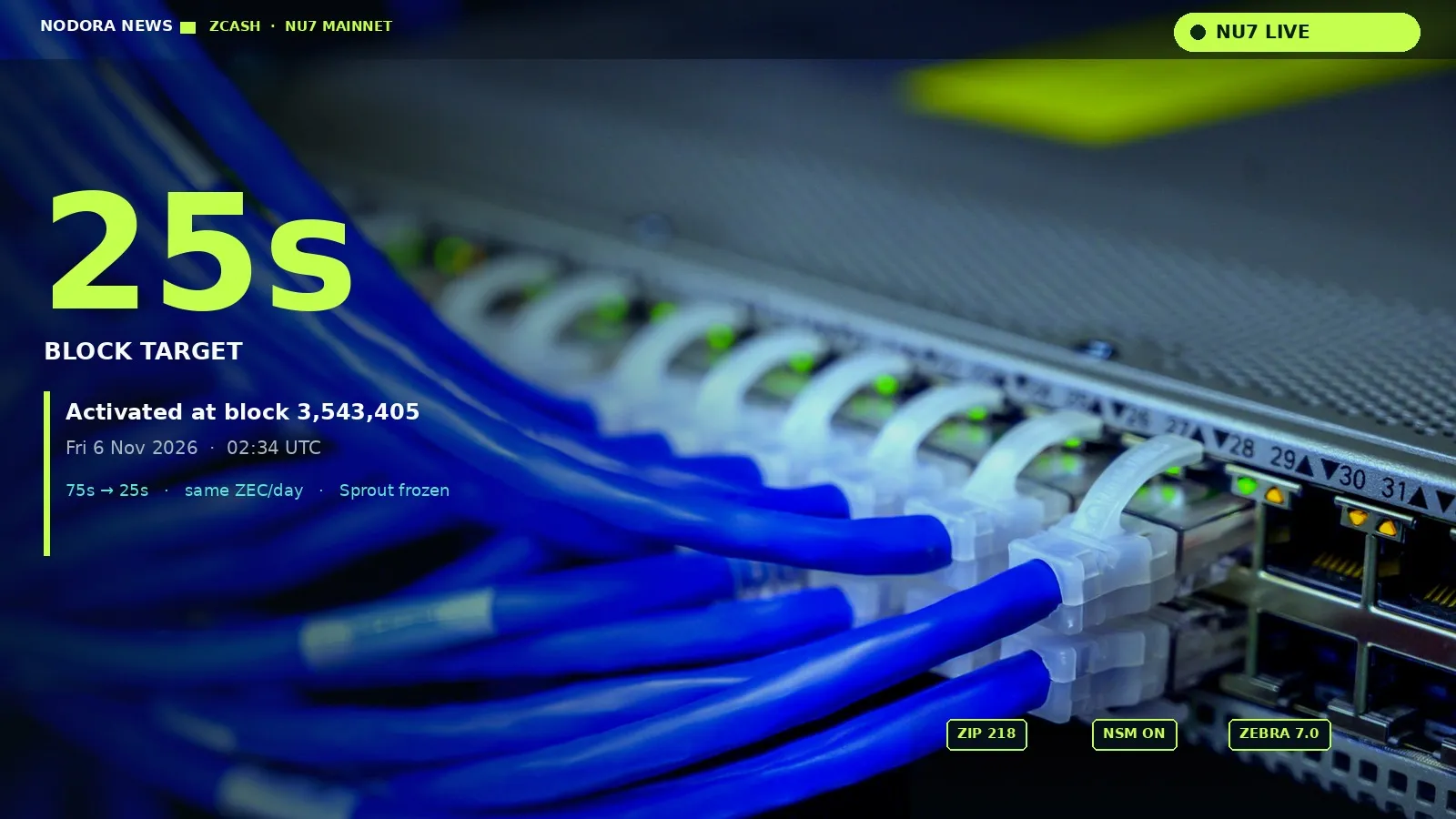
Zcash (ZEC) has activated its NU7 network upgrade on mainnet. The consensus change took effect at block 3,543,405, mined at 02:34 UTC on Friday, November 6, 2026 (8:34 PM Central Time on Thursday, November 5). The chain now targets a block every 25 seconds instead of 75, while keeping the same ZEC issued per day and the same 21 million supply cap.
Key takeaways
- NU7 went live at block 3,543,405 (hash `0000000000246a2b…4ccd4a`), confirmed by ZecStats as active on the tip.
- Target block time: 75s → 25s; subsidy: 1.5625 → 0.52083333 ZEC per block (same ZEC per day).
- Network Sustainability Mechanism: 60% of fees leave circulation into the NSM; miners keep 40%; nothing is burned.
- Version 4 transactions are invalid, so the Sprout pool (~12,224.21 ZEC) is unspendable, not burned.
- Nodes need Zebra 7.0.0 or Zakura 1.7.0+; wallets such as Zodl v3.19.0+ and Zingo 3.0.0 mobile; `zcashd` is not supported for NU7.
What happened
NU7 is a hard consensus upgrade defined by ZIP 259. From the activation height, every upgraded full node enforces a new branch (consensus ID `0x77190AD9`). ZecStats flipped its tracker to "NU7 is live" once the tip sat at or above block 3,543,405 and the node reported the NU7 branch.
The Zcash Foundation shipped Zebra 7.0.0 on October 22 as the first stable release with mainnet NU7 support, telling operators they must upgrade before height 3,543,405 to stay on the consensus chain. Zakura 1.7.0 likewise activates NU7 at that height. Setups that still need a `zcashd`-style interface are pointed at the zcashd-compat v1.3.0 sidecar; stock `zcashd` does not follow NU7.
We covered the last-minute Sprout migration warning before activation in Zcash (ZEC) NU7 Upgrade to Freeze ~$16M Left in Sprout Pool. That deadline has now passed.
The numbers behind NU7
ZIP 218 is the headline change: shorter blocks. Three times as many blocks per day mean the per-block subsidy is cut to one third so daily issuance is unchanged.
- Target spacing: 75 seconds → 25 seconds (~3,456 blocks/day instead of ~1,152).
- Block subsidy: 1.5625 → 0.52083333 ZEC.
- Next halving height: moves to block 6,132,390 (still around late November 2028 on the calendar).
- NSM (ZIPs 235 / 237): 60% of each block's fees leave circulation into the NSM balance; the miner keeps 40%. Reissue of that balance is scheduled from block 8,939,664 (~February 2031). Fees are not destroyed.
- Sprout freeze (ZIP 2003): all version 4 transactions are invalid. Sprout can only move via v4, so the pool is unspendable, not burned. ZecStats showed about 12,224.21 ZEC frozen and an NSM balance near 368.59 ZEC shortly after activation.
- Dev fund address (ZIP 2008): the Zcash Community Grants stream pays a new transparent address from the next address period (~block 3,612,390).
ZIP 259 also lists what NU7 does not include: Zcash Shielded Assets, memo bundles, Crosslink, Tachyon, and no new transaction format or shielded pool.
Why it matters
Faster blocks should cut first-confirmation latency for deposits and payments once difficulty settles toward the new target. ZIP 218 also estimates a higher Orchard-protocol throughput ceiling (about 2.9 to about 6.6 transactions per second) while adding per-block shielded-action limits that bound worst-case light-wallet sync costs.
The NSM is an early fee-era design choice. Instead of burning fees or paying them all to miners, NU7 parks 60% for later reissue on top of the normal subsidy schedule, without changing the 21 million cap or the four-year halving cadence.
For holders, the practical cut-off is Sprout. Coins still in that original 2016 pool cannot be spent under current rules. ZIP 2003 keeps them in supply accounting but says spending "may never be re-enabled." Transparent, Sapling, Orchard and Ironwood balances are not frozen by this rule; only the v4/Sprout path is closed.
Exchanges and custodians may still adjust confirmation counts for the faster cadence and should reject any legacy tooling that still builds version 4 transactions.
Market reaction
ZEC was relatively steady against a softer major-coin tape at draft time (~13:46 AEDT, Friday November 6) on OKX:
- ZEC/USDT: last about $1,311.61 (24h open ~$1,315.53, roughly −0.3%); 24h high $1,335.68, low $1,213.56.
- BTC/USDT: about $76,160 (roughly −5.6%).
- ETH/USDT: about $2,241 (roughly −7.9%).
CoinGecko still ranked ZEC near the top 10 by market cap. Holding flat while bitcoin and ether sold off is notable after a strong pre-upgrade week, but it is not a signal that the activation alone sets price. You can track ZEC beside other large caps on Nodora Charts.
What to watch next
- Block-time settling. Difficulty does not reset at activation; mean times should drift toward 25 seconds as retargeting catches up. ZecStats is tracking post-activation means.
- Wallet and node hygiene. Self-custody users should be on Zodl v3.19.0+ or another NU7-ready wallet. Operators who missed the height risk following a pre-NU7 fork until they upgrade.
- NSM balance growth. Early fee flow into the NSM will be small at today's fee levels, but the balance is now a live chain statistic.
- Exchange deposit policy. Some venues may briefly pause ZEC deposits/withdrawals or raise confirmation requirements around the faster block schedule; check each exchange's notices.
- Any Sprout recovery debate. With ~12,224 ZEC locked from spending, the community may later revisit whether a future upgrade should restore a path, which ZIP 2003 leaves theoretical rather than promised.
This article is for information only and is not financial advice.
SourcesZecStats, Zcash Foundation, Zakura +36
This article is general information, not financial advice.
Open Nodora News in the app