Ethereum (ETH) Layer 2 Base Goes Live With 200ms Blocks
By Nodora News · · Updated
Coinbase’s Base activated its Denim upgrade on 5 November 2026, cutting block time to 200 milliseconds and retiring Flashblocks on the Ethereum (ETH) L2.
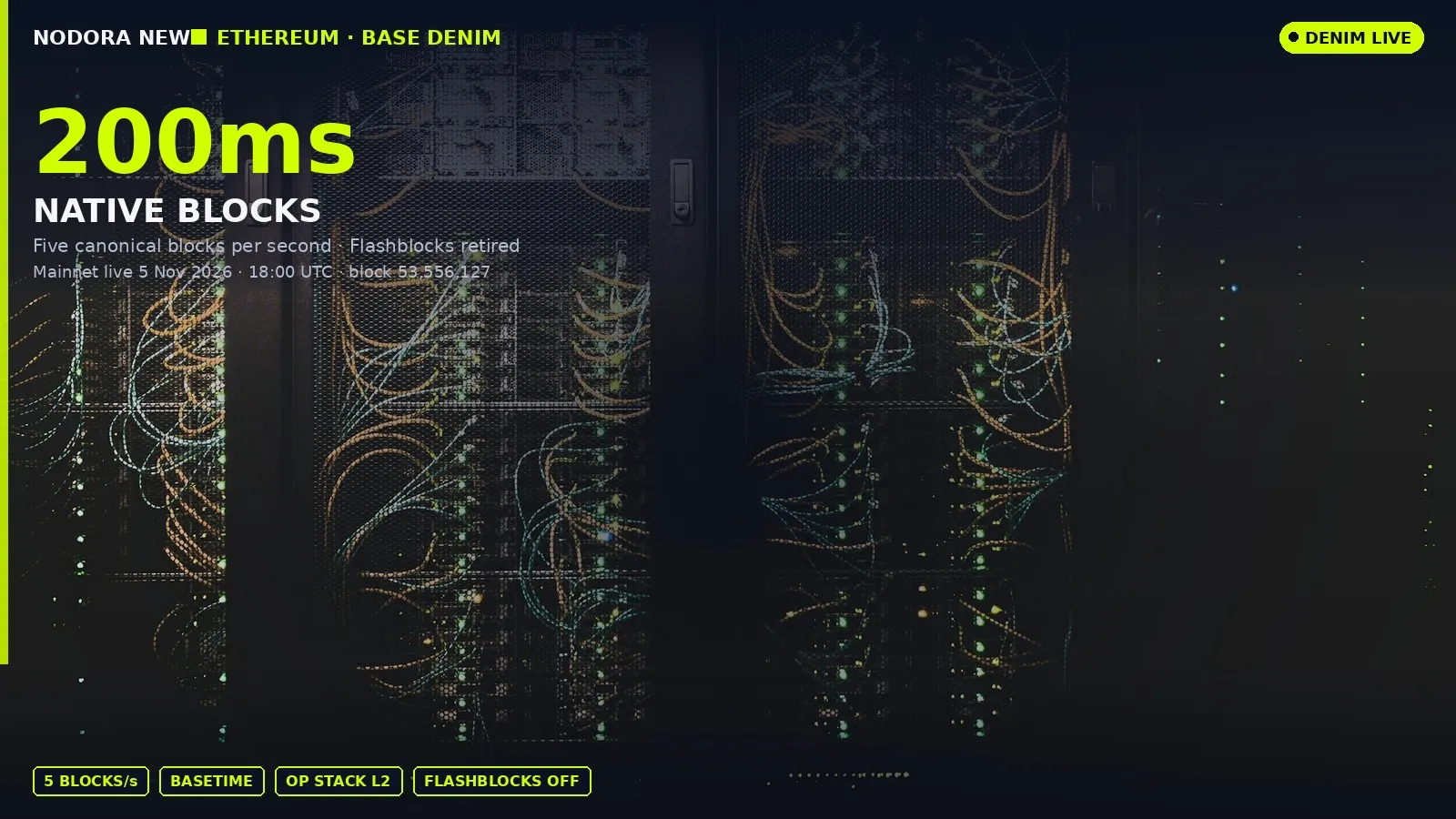
Coinbase’s Ethereum (ETH) layer-2 network Base activated its fourth named upgrade, Denim, on mainnet at 18:00 UTC on 5 November 2026. The change cuts Base’s canonical block time from two seconds to 200 milliseconds — five full blocks every second — and retires the Flashblocks preconfirmation stream that apps had used since mid-2025. Independent RPC checks reported by Unchained put the first 200-millisecond block at height 53,556,127, one second after the scheduled window opened.
Key takeaways
- Denim is live on Base mainnet as of 18:00 UTC on 5 November 2026; first 200ms block was 53,556,127.
- Canonical blocks now arrive every 200 milliseconds (five per second), replacing Flashblocks previews.
- A new BaseTime predeploy and optional RPC `timestampMs` fields give contracts and clients millisecond clocks.
- Any logic that treats block counts as durations now runs about ten times faster in wall-clock time; `block.timestamp` is unchanged.
- Node operators need base/base v1.5.1 or later; apps that subscribed to Flashblocks must move to standard `newHeads` and logs streams.
What Denim changed on Base
Before Denim, Base produced one canonical block every two seconds. Flashblocks, built with Flashbots, streamed incremental pending-state updates about every 200 milliseconds so wallets and trading UIs could show a preview before the real block landed. Those previews could be dropped from the final block, which forced apps to reconcile or walk back state.
Denim makes each 200-millisecond slice a real block with its own number, hash, state root and lifecycle (unsafe, safe, finalized). Base’s engineering blog says there is no separate Flashblocks stream anymore and that the `pending` tag no longer returns a preconfirmed state. Standard JSON-RPC calls — `eth_subscribe("newHeads")`, `eth_getLogs`, `eth_call`, receipts — return the faster cadence without a special client.
Finality rules did not change. Landing in a 200ms block is not settlement by itself. Batches still post to Ethereum, and a Base block is safe when its batch is posted and final when Ethereum finalizes that batch. Blocks also cannot skip slots: each full timestamp must sit exactly 200ms after its parent, so the cadence is enforced by the protocol rather than the sequencer’s wall clock alone.
Denim also ships BaseTime, a predeploy that exposes each block’s sub-second component plus a millisecond Unix helper. Ethereum headers still store whole-second timestamps, so without BaseTime five consecutive Base blocks would share one `block.timestamp`. RPC responses can include optional `timestampMs` fields. B20 tokens also gain stricter transfer-executor checks, invertible compliance policies and a reject when the recipient is the token’s own contract address.
Why 200ms blocks matter for builders
Five blocks per second give lending, DEX and rewards protocols more chances each second to liquidate, rebalance or update oracles. Keepers can act on a 200ms cadence, and interest or reward math can track BaseTime instead of jumping once per second.
The trade-off is sharp for anything that counts blocks as time. Base warns that a system treating a block count as a duration will see that duration shrink to about one tenth after activation. Unchained’s worked example: a 302,400-block “week” at the old two-second cadence would expire in roughly 16.8 hours after Denim. Timelocks, vesting, cooldowns, per-block rate limits, governance voting delays that use `ERC20Votes`’ default block clock, and fixed-cardinality TWAP oracles are all on the audit list. Contracts that compare `block.timestamp` keep their wall-clock timing; immutable contracts that baked in a block count cannot retune it now that Denim is live.
App and indexer teams that consumed Flashblocks need to migrate: `newFlashblocks` maps to `newHeads`, pending-log subscriptions map to ordinary logs, and there is no direct equivalent of the old pending preconfirmation tag. Node operators must run base/base v1.5.1 or later (v1.5.3 fixed a separate state-root bug). Shortly after activation, Base’s status page said Denim had successfully activated while the team investigated periodic inclusion delays and a higher share of empty blocks; Unchained’s early samples showed many system-only blocks in the first minutes, with later hourly samples cleaner.
Market reaction and Ethereum context
Base does not have its own major circulating gas token; fees and settlement still point at Ethereum. The upgrade landed into a weak crypto tape from the Nasdaq and semiconductor selloff Nodora covered earlier on 6 November. On OKX at draft time, Ethereum (ETH) traded near $2,232, down about 8.0% over 24 hours, Bitcoin (BTC) near $75,753 (−6.0%), and Optimism (OP) near $0.104 (−6.1%). Those moves look like broad risk-off beta rather than a Denim-specific price signal.
For readers comparing other recent chain upgrades, Nodora covered Zcash (ZEC) NU7 going live with 25-second blocks on the same calendar day, a different stack but the same theme of networks tightening block cadence. Nodora’s earlier Optimism (OP) fee-rebate story sits in the same OP Stack neighbourhood if you are tracking how Coinbase’s L2 and Optimism’s public chain evolve in parallel. Live ETH pricing and related majors are on Nodora’s charts page.
What to watch next
- Whether empty-block and inclusion-delay notes on Base’s status page stay resolved through the first full week of Denim traffic.
- How quickly wallets, indexers and Flashblocks-dependent apps finish migrating to canonical `newHeads` streams.
- Contract and DAO reviews of block-count timelocks, vesting and governance clocks that may now expire ten times faster.
- B20 issuer tooling updates for transfer-executor allowlists and the new invalid-receiver rule.
- How OP Stack L3s that cannot follow Denim (Horizen already flagged a halt) finish user migrations.
- Follow-on Base upgrades; the public upgrades board lists Everest next with no date yet.
This article is news coverage, not investment advice. Protocol behaviour, node requirements and app migrations can change; builders should follow Base’s official Denim docs and release notes.
SourcesBase, Unchained / Yahoo Tech, Base Docs +26
This article is general information, not financial advice.
Open Nodora News in the app