Solana (SOL): Samsung Wallet Launches USDC for U.S. Users
By Nodora News ·
Samsung Wallet's Stablecoin Account is live for eligible U.S. Galaxy users, letting them buy, hold and send USDC on Solana across about 82 million devices.
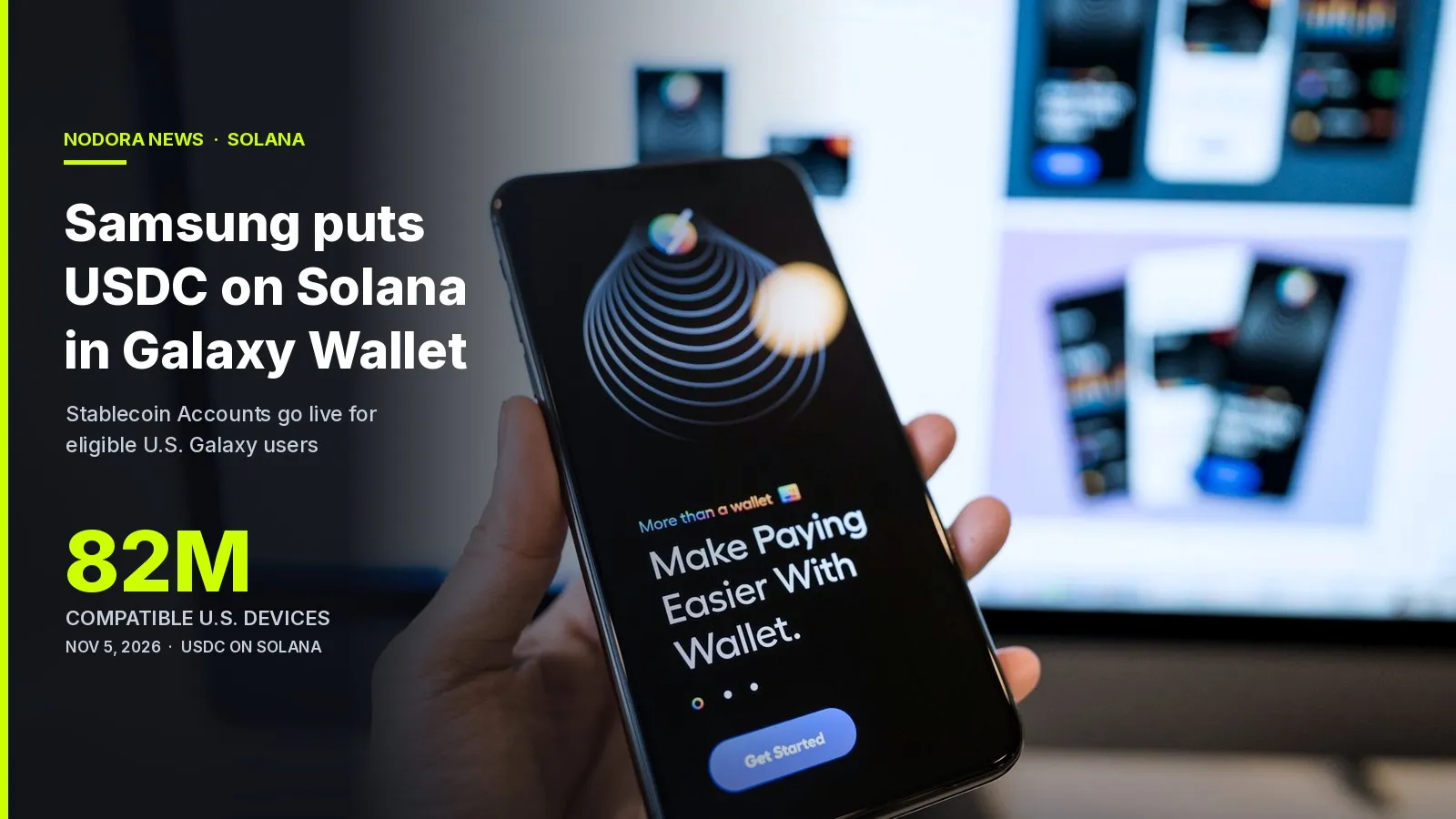
Samsung Electronics has switched on Stablecoin Accounts inside Samsung Wallet for eligible U.S. Galaxy users, letting them buy, hold, send and receive USDC on Solana (SOL) from the same app that already holds cards, boarding passes and IDs. The rollout was confirmed on Thursday, November 5, 2026, after an October announcement that originally pointed to a late-October launch. Samsung says about 82 million compatible Galaxy devices in the United States can use the feature.
Key takeaways
- Samsung Wallet's Stablecoin Account is live for eligible U.S. Galaxy users (18+, Android 13+, fingerprint auth); New York residents are excluded.
- Balances are Circle's USDC on the Solana network; users do not manage private keys or install a separate crypto app.
- Licensed custodian Bastion runs the accounts; Coinbase holds USDC as sub-custodian via Coinbase Prime Vault.
- Peer and external-wallet USDC transfers have no Samsung fee; bank payouts to 60+ countries and card top-ups carry fees (card top-ups cited at 4%).
- Solana (SOL) traded near $90.22 on OKX at draft time, about 4.9% lower over 24 hours amid a broader market selloff.
What Samsung launched
The Stablecoin Account sits inside Samsung Wallet rather than beside it. Eligible users can top up from a bank account or card, convert dollars to USDC, send USDC to another Samsung Wallet user by Samsung Account email, or move USDC to a compatible external wallet on a supported network. They can also send money to qualifying bank accounts in more than 60 countries, where recipients may receive local currency.
Samsung and partners stress that this is a crypto wallet, not a bank deposit. USDC balances and optional rewards are not covered by FDIC, NCUA or SIPC protections. Fingerprint authentication is required each time a user opens the account or approves a transaction.
The company first detailed the Solana partnership on October 7, 2026, with Solana Foundation president Lily Liu arguing that stablecoins had proved the technology works but still needed a mainstream distribution channel. Samsung's Woncheol Chai, who leads the digital wallet team in the mobile business, said the goal is to let Galaxy users move money without "the complexity of traditional crypto tools," with Solana providing the settlement rail at Samsung's scale.
How custody and fees work
Bastion, a licensed money transmitter and stablecoin custodian, provides the custodial wallet, transfers and remittances. USDC is held in Coinbase's institutional custody under Bastion's arrangement with Coinbase Prime Vault. Purchases via bank or card are processed with Stripe and ramp partners including Bridge; withdrawals to bank or debit card use Coinflow and its banking partners, according to Samsung's U.S. FAQ.
Samsung charges no fee to open the account and no Samsung fee for USDC sends to other Samsung Wallet users or compatible external wallets (other providers may still charge). Credit-card top-ups, including through Samsung Pay, carry a 4% fee in coverage of the launch. Bank and debit withdrawals also carry fees that vary by method. New users who make a first top-up of $50 or more can receive $25 in USDC, according to Decrypt's reporting of the launch terms. Optional rewards can accrue daily on USDC balances, with a stated cap of up to 1,500 USDC per calendar year; rates can change and rewards may be taxable.
Eligibility is limited to U.S. residents 18 or older with a Samsung Account and a Galaxy device that supports Samsung Wallet, runs Android 13 or later, and has built-in fingerprint authentication. New York is carved out. Samsung said it expects to explore in-store and online stablecoin payments and additional markets, subject to local rules.
Why Solana (SOL) and USDC matter here
Putting USDC on Solana inside a phone wallet used by tens of millions of people is a distribution story as much as a chain story. Circle's USDC is already one of the largest dollar stablecoins by circulation; Solana has been a busy venue for USDC transfers and tokenized funds. Nodora recently covered Schroders bringing an emerging-market bond strategy onto Solana and Circle's Q3 results, when on-chain USDC volume hit $13.9 trillion.
For Solana, the practical win is default settlement for remittances and peer transfers that never ask the user to pick a network, seed phrase or gas token. For Circle and Coinbase, it extends USDC and institutional custody into a hardware brand's first-party wallet. For users, the trade-off is custodial convenience: Samsung and Bastion can restrict accounts for compliance, and irreversible wrong-network sends remain a risk the FAQ warns about in plain language.
Market reaction
The launch landed on a risk-off day for crypto. On OKX around draft time Friday morning in Melbourne:
- Solana (SOL): about $90.22, roughly −4.9% over 24 hours (session range about $88.76–$97.10)
- Bitcoin (BTC): about $76,212, roughly −4.9%
- Ethereum (ETH): about $2,251, roughly −6.9%
Those moves track the broader Nasdaq-linked selloff Nodora covered earlier, not a Solana-specific reaction to Samsung. A phone-wallet launch rarely reprices SOL in a single session; the longer test is whether Galaxy users actually top up, remit and keep USDC balances on Solana after the novelty fades. Live prices and charts are on Nodora's Charts page.
What to watch next
Watch three threads. First, uptake: Samsung has not published early deposit or remittance figures, so on-chain USDC mint/burn and Solana transfer growth after the U.S. launch will be the public proxy. Second, product scope: whether Samsung adds in-store or online USDC payments, more networks, or markets outside the U.S. Third, the regulatory perimeter: New York is already excluded, rewards and remittances sit under money-transmitter and tax rules, and any freeze or outage at Bastion or Coinbase would hit balances users treat like wallet cash.
None of that is investment advice. Samsung Wallet's USDC account is a mainstream distribution bet for Solana-settled dollars; whether it becomes a daily money habit is the story still ahead.
SourcesThe Block, Decrypt, Samsung +14
This article is general information, not financial advice.
Open Nodora News in the app