South Korea Crypto Tax: Ruling Party Proposes Fourth Delay
By Nodora News ·
South Korea's ruling party formally proposed delaying the 22% crypto income tax due in January 2027, which would be the fourth postponement since 2020.
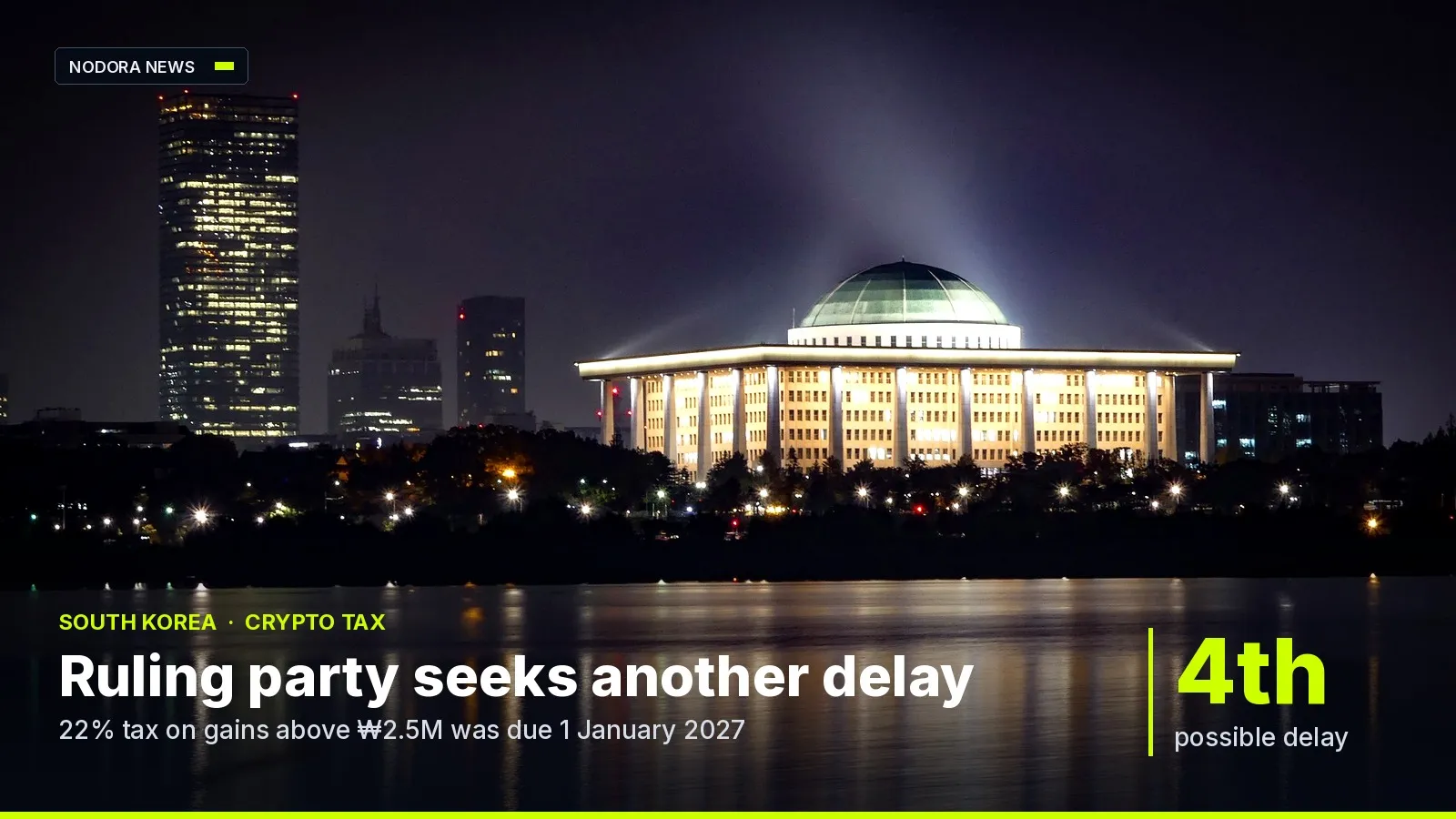
South Korea's ruling Democratic Party has formally asked the government to postpone the country's crypto income tax, which is due to start on 1 January 2027. Party leader Kim Min-seok made the proposal on Wednesday, 4 November, at a supreme council meeting in the National Assembly in Seoul. If the government agrees, it would be the fourth time the levy has been pushed back since it was written into law in 2020. Bitcoin (BTC) and the wider market barely reacted, with BTC trading around $76,400 on OKX.
Key takeaways
- The Democratic Party formally proposed delaying South Korea's crypto income tax, now set for 1 January 2027.
- The tax would take 22% (including local tax) of yearly crypto gains above 2.5 million won, about $1,870.
- Party lawmakers favour a delay of roughly two years, which points to 2029.
- The party wants the Digital Asset Basic Act passed first, so the market has a full legal framework before tax applies.
- This would be the fourth postponement since the tax was legislated in 2020.
What happened: Democratic Party formally proposes crypto tax delay
Kim said the party had reached its position after talks between the party and the government, and after meetings with crypto businesses led by the National Assembly's finance committee. According to Yonhap and The Asia Business Daily, he said the party agreed it would be better to first enact the Digital Asset Basic Act and give companies and investors time to adapt, after weighing tax principles, the state of the domestic industry and fairness between users.
The move follows a recommendation made a day earlier. On 3 November, Rep. Oh Ki-hyung, the party's senior member on the finance committee, told reporters that many committee members backed the basic principle that income should be taxed, but that most agreed more preparation time was unavoidable. He said the majority view was a delay of about two years, and that the issue could be discussed again within the next week or two.
Kim also promised that, unlike past delays, the party would set a clear deferral period this time and prepare the groundwork properly, including the use of overseas transaction data, checks on electronic systems and notices for taxpayers.
How South Korea's crypto income tax would work
The rules themselves are not changing in this proposal, only the start date. As currently written:
- Rate: 22%, made up of national income tax plus local income tax.
- Threshold: only yearly gains above 2.5 million won (about $1,870) are taxed.
- What counts: gains from selling or lending crypto assets.
- Start date: 1 January 2027, unless the law is amended again.
The tax has been delayed repeatedly since 2020. The new push is the first time the ruling party leadership has formally backed another delay.
Why the delay matters for Korean crypto investors
South Korea is one of the world's busiest crypto markets, with a large retail base trading on local exchanges such as Upbit and Bithumb. A tax on gains would directly affect millions of traders, so the timing matters.
The main argument for waiting is data. South Korea can see trades on its own exchanges, but it has limited visibility into what residents do on overseas platforms. That would change under the OECD's Crypto-Asset Reporting Framework (CARF), a system for countries to automatically share crypto account information with each other. Supporters of a delay say that taxing only domestic users before that data arrives would be unfair to people who trade at home.
That reasoning already appears in a bill filed on 15 October by Democratic Party lawmaker Park Min-kyu. It would start the tax on 1 January of the second year after South Korea first exchanges crypto data under CARF, which in practice means 2029. Opposition People Power Party lawmakers have filed their own bills, one to scrap the tax provisions altogether and others to delay them. Last week, The Block reported that the presidential office was also discussing a postponement to 2029 to match the US timeline for joining CARF.
Market reaction: Bitcoin and Korean exchange prices
Traders treated the news as largely expected, since a delay had been widely discussed for weeks. Prices at the time of writing:
- Bitcoin (BTC): about $76,430, down 0.7% in 24 hours (OKX)
- Ether (ETH): about $2,247, down 0.3% (OKX)
- XRP: about $1.26, up 0.6% (OKX)
- BTC on Upbit: about 102.7 million won, down 1.6% on the day
The broader market is still digesting the record $6.3 billion Binance hack, which also pushed Korean regulators to tighten exchange security. Nodora covered that response in South Korea tells exchanges to boost cold storage. You can track prices on Nodora Charts.
What to watch next
- The government's answer. The finance ministry still has to respond. The government had been preparing to implement the tax and said in October it would gather views from lawmakers, experts and industry.
- The deferral period. The party has promised a fixed date this time. A two-year delay to 2029 is the most likely outcome based on current proposals.
- The Digital Asset Basic Act. The party wants this broad crypto law passed first, so progress on it will shape the tax timeline.
- Law change before 1 January. Any delay needs an amendment to the Income Tax Act before the start date. Without one, the 22% tax would apply from 2027.
For now, Korean crypto traders face no change, but the direction of travel is clear: the ruling party wants the market's legal framework and cross-border data sharing in place before any tax bill arrives.
This article is for information only and is not financial or tax advice.
SourcesYonhap News Agency, The Block, The Asia Business Daily +15
- Yonhap News AgencyRuling party proposes gov't delay planned taxation of cryptocurrency
- The BlockSouth Korea's ruling party formally proposes deferral of crypto income tax
- The Asia Business DailyRuling Party formally proposes deferral of virtual asset income tax to government
- The Asia Business DailyDemocratic Party finance committee recommends deferral to party leadership
- Yonhap (Korean)Democratic Party files first crypto tax deferral bill, implementation from 2029
This article is general information, not financial advice.
Open Nodora News in the app