Bitcoin (BTC): Russia Clears Retail List for BTC, ETH, USDT
By Nodora News ·
Russia’s central bank named Bitcoin (BTC), Ether and USDT for non-qualified investors from Nov. 17, with a ₽300,000 yearly cap per intermediary.
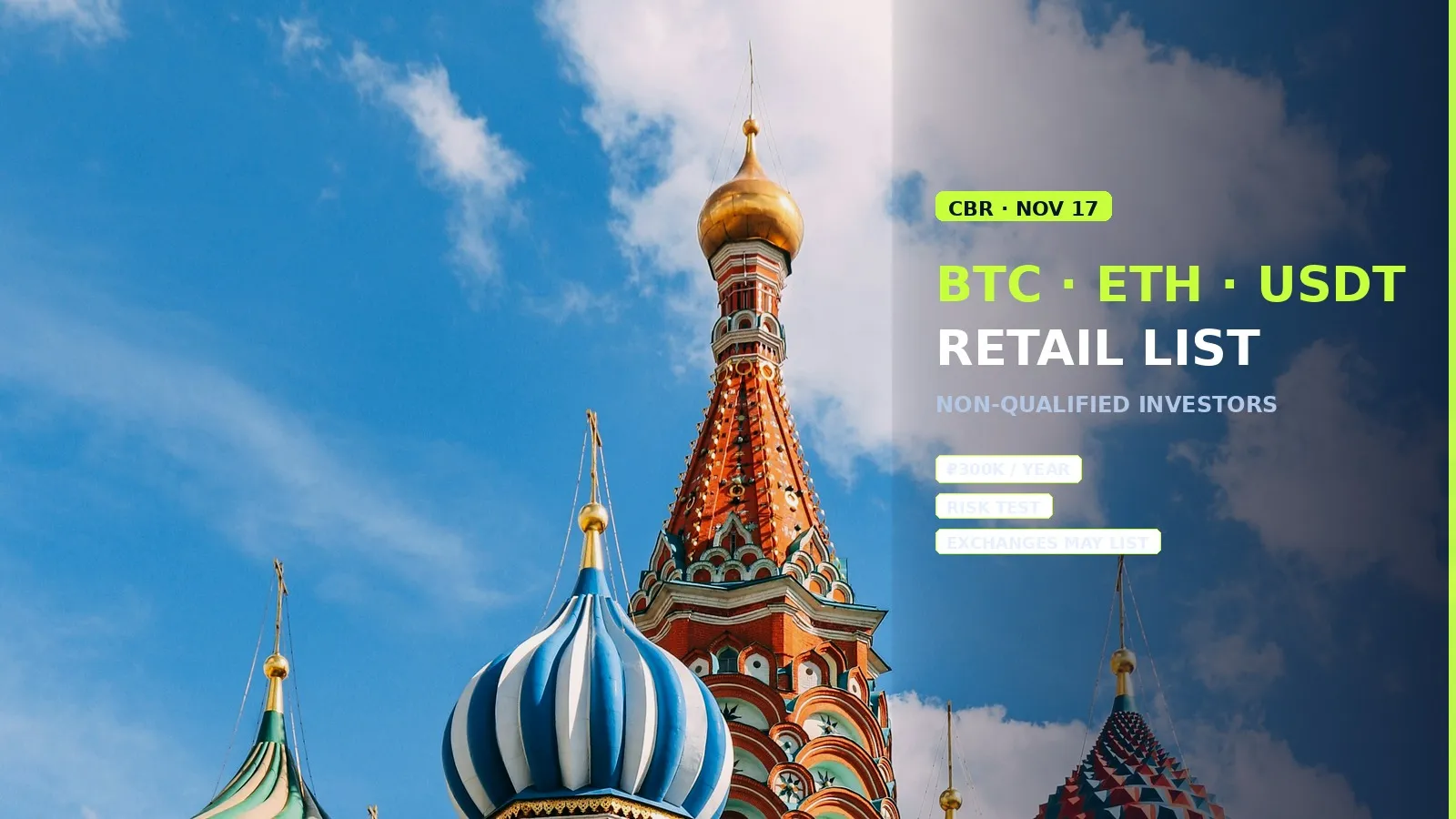
Russia’s central bank has published the official list of cryptocurrencies that non-qualified investors may buy once the rules take effect on November 17, 2026. The Bank of Russia said Bitcoin (BTC), Ethereum’s Ether and Tether’s USDT are the only assets exchanges may admit to public trading for that retail segment — a concrete next step after Moscow Exchange already said it plans pilot BTC, ETH and USDT trading from December 1.
The directive does not force every venue to list the three assets. It gives trading organizers the right to admit them from November 17, and it locks in the retail purchase cap and testing rules that sit around Russia’s broader digital-asset law.
Key takeaways
- Bank of Russia on November 6 named Bitcoin, Ether and USDT as the cryptocurrencies available to non-qualified investors.
- The guidance takes effect November 17, 2026; from that date exchanges may admit those assets to public circulation.
- Non-qualified buyers face a ₽300,000 (~$3,660) annual purchase limit per intermediary (broker, manager or crypto-exchange desk), on exchange or OTC.
- Qualified investors face no purchase limit and may access any crypto assets under the framework.
- Every investor, qualified or not, must pass a risk test and review crypto-investment risks before trading.
- Selection criteria include market capitalization, average daily volume and at least five years of pricing history on foreign venues.
What the Bank of Russia announced
In a November 6 press release, the Bank of Russia said it had determined the list of cryptocurrencies accessible to non-qualified (“неквалов”) investors. The list comprises Bitcoin, Ether and USD Tether. The regulator’s guidance enters into force on November 17, after which exchanges have the right to authorize those assets for public circulation.
Retail clients will be able to buy through brokers, asset managers or crypto-exchange intermediaries, on organized markets or over the counter. The annual buy limit through one intermediary is no more than 300,000 rubles. Anadolu Agency put that figure at about $3,660 at the time of reporting.
Qualified investors remain outside the purchase cap and may trade any crypto assets without that retail ceiling. The central bank stressed that all investors must complete testing and review risk disclosures before a transaction.
Why only three assets made the cut
The Bank of Russia said the list covers only the most liquid assets whose criteria are set in law. Selection weighed market capitalization, average daily trading volume and a price history of at least five years on foreign platforms. The stated goal is to reduce risk for non-qualified investors who put money into crypto.
USDT is treated in the framework as a foreign digital instrument that can still be admitted to public trading once the guidance is live, alongside Bitcoin and Ether as digital currencies. Exchanges are permitted, not obligated, to list them.
How this fits Moscow Exchange’s December plan
The central-bank list is the retail-product rulebook that sits next to venue plans already in motion. Moscow Exchange said earlier in November that it intends to start pilot trading in Bitcoin, Ether and USDT from December 1, with National Clearing Centre clearing and partner digital depositories for custody — a rollout Nodora covered when the exchange first detailed the timetable.
November 17 therefore matters as the date when the retail list and purchase rules become operative; December 1 remains the exchange’s own target for pilot markets. Actual listings still depend on each organizer’s readiness, custody arrangements and compliance with the testing and limit rules.
Market reaction
Bitcoin and Ether were not reacting in isolation to the Russian guidance at draft time. On OKX, Bitcoin traded near $75,744, down about 1.2% over 24 hours, while Ether was near $2,230, down about 1.9%. Broader crypto markets were still digesting the prior session’s risk-off move tied to equity and AI-stock weakness rather than a single Russia headline.
Retail access in Russia remains tightly capped for non-qualified buyers, so the near-term impact is more about rule clarity and exchange readiness than an open flood of new demand. Traders watching the story will focus on whether Moscow Exchange and other organizers actually open books after November 17 and how strictly intermediaries enforce the ₽300,000-per-year cap.
For live prices and cross-asset context, Nodora’s Charts page tracks major pairs alongside related coverage such as Bitcoin (BTC) Trading Comes to Moscow Exchange on December 1 and Nigeria CBN Sets ₦15bn Stablecoin Issuer Capital Rules.
What to watch next
- Whether Russian exchanges, including Moscow Exchange, publish listing notices once the November 17 window opens.
- How brokers and crypto-exchange desks implement the ₽300,000 annual cap and risk-testing workflow for non-qualified clients.
- Any expansion of the retail list beyond Bitcoin, Ether and USDT if liquidity criteria are met later.
- Custody and clearing details as December 1 pilot trading approaches.
This article is for information only and is not financial advice.
SourcesBank of Russia, Anadolu Agency, TASS +25
- Bank of RussiaКриптовалюта для неквалов: указание Банка России
- Anadolu AgencyRussia approves Bitcoin, Ether, USDT for exchange trading
- TASSBank of Russia determined cryptocurrencies accessible for ordinary investors
- The DefiantBank of Russia Clears Bitcoin, Ether and USDT Rules for Nov. 17
- Crypto BriefingRussia's central bank approves Bitcoin, Ether and USDT trading for retail investors
This article is general information, not financial advice.
Open Nodora News in the app