South Korea Crypto Tax: Government Seeks Delay to 2029
By Nodora News · · Updated
South Korea’s finance minister said the government will seek a two-year delay of crypto income tax to 2029, citing U.S. data exchange under CARF.
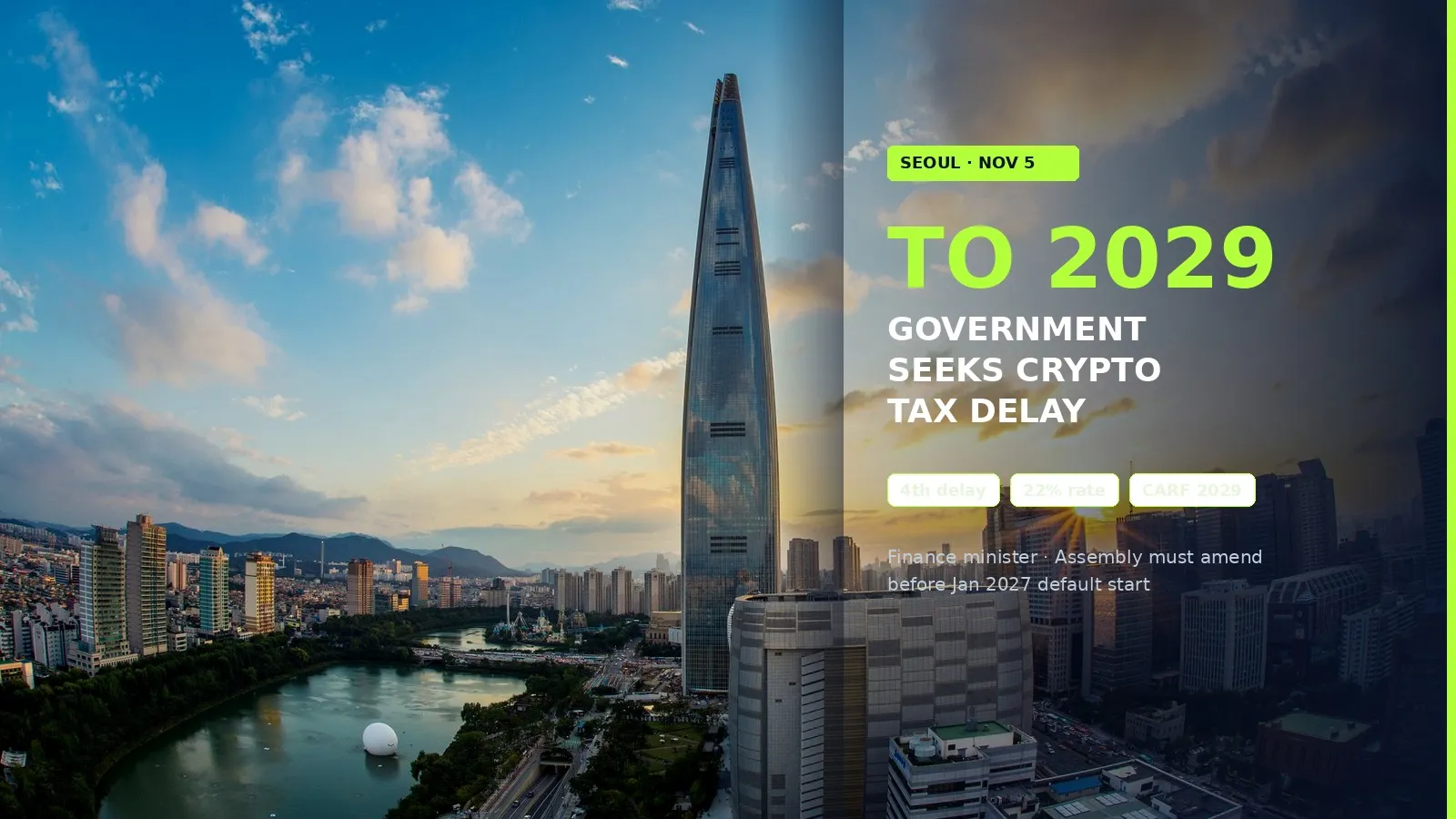
South Korea's government will ask the National Assembly to push cryptocurrency income taxation back by two years to 2029, Finance and Economy Minister Lee Hyeong-il said on 5 November 2026. The move would be the fourth delay since the tax was legislated in 2020 for a 2022 start, and it follows a ruling-party push earlier in the week. Officials tied the timeline to overseas trading data the country expects to receive from the United States under the OECD Crypto-Asset Reporting Framework (CARF) from 2029.
Key takeaways
- Finance Minister Lee Hyeong-il said Seoul will work with the National Assembly to delay the virtual-asset income tax from January 2027 to 2029.
- If lawmakers agree, it would be the fourth postponement since the 2020 law that first targeted a 2022 launch.
- The government cites U.S. crypto-transaction information exchange under CARF from 2029 and the need to align rules with a forthcoming Digital Asset Act.
- Officials also want a three-year loss carryforward so losses in a tax year can offset gains in later years, similar to U.S. and U.K. practice.
- As drafted today, individuals would still face 22% tax (including local income tax) on annual net crypto gains above 2.5 million won once the regime starts.
What the government announced
Speaking at a press briefing in Seoul, Lee said it weighed heavily to propose another delay after three prior postponements. The Ministry of Economy and Finance said a 2027 start could put the domestic market at a disadvantage if overseas trades remain harder to verify than local ones. Under CARF, South Korea and the United States are set to begin exchanging crypto-asset account information in 2029. Lee argued that waiting until those feeds arrive would let Seoul tax investors who use U.S. platforms on a more equal footing with domestic traders.
The ministry also flagged the Digital Asset Act, which is meant to set rules for digital-asset businesses and strengthen user protection. Officials want tax rules to track that legislation rather than lock in a 2027 start while the industry framework is still moving. A public-private working group of industry, experts and agencies is due to meet soon and work through the first half of 2027 on transaction-type rules and simpler filing. Any further statutory changes would be aimed at the 2027 regular session of the National Assembly, with detailed guidelines planned for the first half of 2028.
How the tax would work once it starts
Nothing in Thursday's briefing rewrote the headline rate. Under the law as it stands, individuals would pay 22%, including local income tax, on the portion of annual net income from selling or lending virtual assets that exceeds 2.5 million won (about US$1,870 at recent exchange rates). Same-year losses can already offset same-year gains; losses from earlier years cannot.
The new proposal would let investors carry losses forward for up to three years once taxation begins. Korea Herald reporting said losses realized in 2029 could offset gains through 2032, while losses booked before the tax takes effect would not qualify. That design mirrors approaches used in the United States and Britain and is meant to soften the impact of crypto's price swings on a single tax year.
To change the start date, the Assembly must amend the Income Tax Act before January 2027. Lee said the government would seek approval for both the delay and the loss-carryforward language in this year's regular session.
Why the delay matters for Bitcoin and the wider market
South Korea is one of Asia's deepest retail crypto markets, with large won-denominated volumes on Upbit, Bithumb and other licensed venues. A firm 2027 start would have forced exchanges and brokers to finish reporting systems under still-contested guidance; industry groups have said unclear requirements slowed testing. Pushing the clock to 2029 also lines up with CARF and with Hong Kong's crypto tax reporting law, which Nodora covered when LegCo passed its Inland Revenue amendment.
The announcement lands while Bitcoin (BTC) and other major coins are under pressure from a broader risk-off move in U.S. equities. On OKX at draft time, BTC traded near $75,970, down about 5.8% over 24 hours, and Ethereum (ETH) near $2,236, down about 7.9%. Those moves reflect the same Nasdaq and semiconductor selloff Nodora reported earlier on 6 November, not a Korea-specific shock. Still, clearer tax timing can matter for how Korean residents size positions into year-end. Track live prices on Nodora's Charts page.
For readers tracking other capital-gains frameworks, Greece this week approved a 10% crypto gains tax with a €500 annual exemption, a different path from Seoul's delay-and-prepare approach. Nodora's earlier note on the Democratic Party of Korea's delay proposal set the political stage; Thursday's briefing is the executive branch formally joining that push.
What to watch next
- Whether the National Assembly amends the Income Tax Act before the January 2027 default start.
- The first meetings of the digital-asset tax working group and any draft guidelines in 2027–2028.
- Progress on the Digital Asset Act alongside FSC work on market structure and user protection.
- First CARF exchanges with the United States in 2029, which Seoul says are central to taxing overseas trades fairly.
- How licensed Korean exchanges finish cost-basis and reporting tooling once the new date is locked in.
None of this is tax or investment advice. Rules can change in the Assembly, and taxpayers should rely on official ministry guidance and licensed advisers when the final text lands.
SourcesYonhap, The Korea Herald, Korea.kr (MOEF) +25
- YonhapS. Korea to seek 2-year delay in tax on cryptocurrency gains
- The Korea HeraldKorea seeks another delay to crypto tax until 2029
- Korea.kr (MOEF)가상자산 소득과세 2년 유예 추진…2029년 시행 기반 마련
- Bloomberg TaxSouth Korea to Delay Crypto Taxation by 2 Years to 2029
- OKXBTC-USDT and ETH-USDT spot tickers (prices at draft)
This article is general information, not financial advice.
Open Nodora News in the app